
In March 2023, the IPCC released its Sixth Assessment Report, calling on the world to reduce carbon dioxide emissions by 65% from 2019 levels by 2035 if there remains any hope of keeping the window open to realize the 1.5 degree target.
The G7 Summit should take up IPCC's call and submit emissions reduction targets for 2035, including an enhanced target for 2030, well in advance of COP30 in 2025. As the G7 Summit host country, the Japanese government has a responsibility to take the lead in implementing the declaration made at the Summit.
Renewable Energy Institute's report released in April 2023 is the fiirst in Japan since the release of the IPCC report to present the potential of supplying more than 80% of electricity in Japan from renewable energy sources by 2035, while identifying its possibilities and challenges with the aim of achieving a 65% reduction in CO2 emissions.
Renewable Energy Institute has previously published reports proposing an energy mix for 2030 and pathways for Japan to realize a carbon-free energy system by 2050. We hope that these series of reports will stimulate discussions toward the realization of Japan's decarbonization strategy and energy policy necessary to achieve the 1.5 degree target.
The G7 Summit should take up IPCC's call and submit emissions reduction targets for 2035, including an enhanced target for 2030, well in advance of COP30 in 2025. As the G7 Summit host country, the Japanese government has a responsibility to take the lead in implementing the declaration made at the Summit.
Renewable Energy Institute's report released in April 2023 is the fiirst in Japan since the release of the IPCC report to present the potential of supplying more than 80% of electricity in Japan from renewable energy sources by 2035, while identifying its possibilities and challenges with the aim of achieving a 65% reduction in CO2 emissions.
Renewable Energy Institute has previously published reports proposing an energy mix for 2030 and pathways for Japan to realize a carbon-free energy system by 2050. We hope that these series of reports will stimulate discussions toward the realization of Japan's decarbonization strategy and energy policy necessary to achieve the 1.5 degree target.
Proposals towards 2030
-
- Reports & Proposals
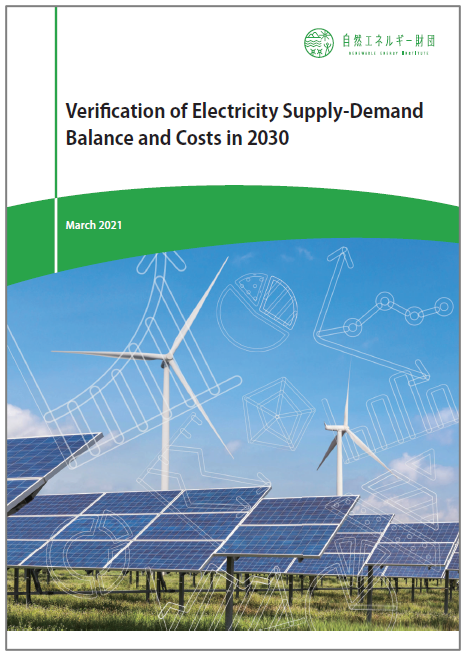
Verification of Electricity Supply-Demand Balance and Costs in 2030
26 March 2021 - In the “Proposal for 2030 Energy Mix in Japan (First Edition)” released in August 2020, Renewable Energy Institute identified two issues requiring further consideration in connection with the sustainable energy mix: stable supply at all hours, and affordable energy supply. This study considers these two issues in detail by conducting analysis using an inter-regional supply-and-demand model.
- Reports & Proposals
-
- Reports & Proposals
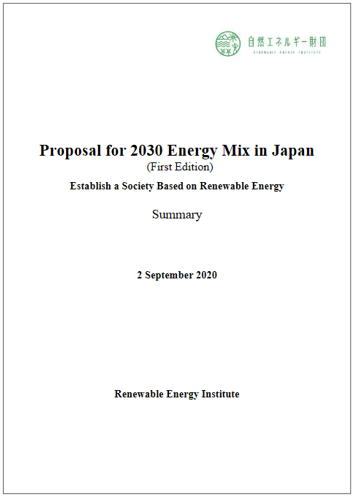
Proposal for 2030 Energy Mix in Japan (First Edition)
Establish a Society Based on Renewable Energy
2 September 2020 (original Japanese released in August 2020) - This proposal shows that it is feasible to achieve a "sustainable electricity generation mix", which is supplied by 45% of renewable energy and not dependent on nuclear nor coal-fired generation by 2030, provided that the appropriate policy measures are taken to realize this energy transition.
- Reports & Proposals
Proposal towards 2035
-
- Reports & Proposals
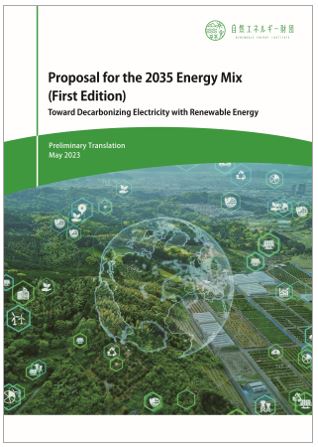
Proposal for the 2035 Energy Mix (First Edition)
Toward Decarbonizing Electricity with Renewable Energy
11 April 2023 - This report is the first in Japan since the release of the IPCC report to present the potential of supplying more than 80% of electricity in Japan from renewable energy sources by 2035, while identifying its possibilities and challenges with the aim of achieving a 65% reduction in CO2 emissions. The report specifically analyzes the current development status of solar power, as well as both onshore and offshore wind power, and makes seven recommendations for accelerating their introduction. Further, if 80% of electricity is supplied by renewables, the cost of fossil fuels required for power generation can be reduced by 80%, saving approximately 4 trillion yen annually in overseas capital outflow.
- Reports & Proposals
Proposals towards 2050
-
- Reports & Proposals
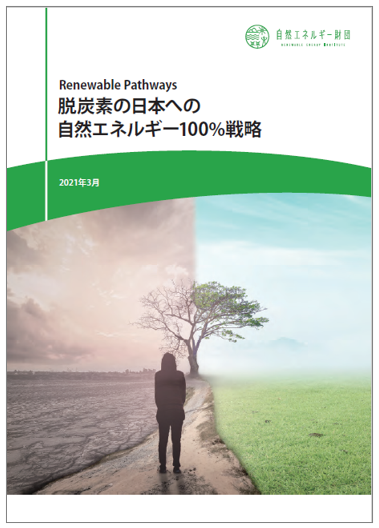
Renewable Pathways: The Strategies to 100% RE for a Carbon-neutral Japan
9 March 2021 (in Japanese) - The report examines renewable pathways to Japan's 2050 decarbonization and suggests the most critical policies that need to be implemented based on an additional analysis made on the REI-Agora-LUT joint study.
Since Prime Minister Suga declared Japan to become carbon-neutral by 2050, discussions for attaining zero-emissions has accelerated. The report responds to the ongoing discussions on targets and policy for 2030 and 2050, as well as discussions on the revision of Japan’s Strategic Energy Plan and Global Warming Countermeasure Plans.
- Reports & Proposals
-
- Joint Study
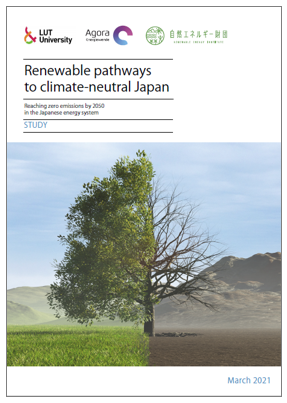
Renewable Pathways to Climate-neutral Japan
Reaching Zero Emissions by 2050 in the Energy System
9 March 2021 - A joint report by Renewable Energy Institute (REI), Agora Energiewende, and LUT University finds that a zero-carbon energy supply based solely on renewables would be affordable in Japan. The study sets forth a three-step roadmap for renewables deployment and electrification.
- Joint Study
-
- Reports & Proposals
Proposal for Energy Strategy Toward a Decarbonized Society
Achieving a Carbon-Neutral Japan by 2050
31 May 2019 (original Japanese released in April 2019) - The Long-Term Strategy to be formulated by the government should be centered around energy efficiency and renewable energy expansion, in order to enable significant reduction in domestic CO2 emissions through to 2030 and forging a path to zero net emissions by 2050. From this point of view, the proposal raises particularly important issues, together with accompanying data, around the topic of electricity generated from renewable energy, coal-fired power, CCS and hydrogen evaluation, industry, buildings, and traffic measures.
- Reports & Proposals