

(Originally published in Japanese on 9 October 2026)
Although electrification policies have already been advanced in the EU and in some U.S. states, the crisis in the Middle East has underscored the risks associated with fossil fuel dependence, and electrification is now emerging as an increasingly global policy priority. Japan has a relatively high electrification rate by international standards and possesses advanced heat pump technologies that are essential for the electrification of heat, placing it in a strong position to lead global efforts toward electrification. We therefore propose that Japan actively engage in and support this growing global movement.
1. Proposal toward the Global 35% Electrification Target
|
The Government of Japan should actively engage in and endorse the goal of raising the global electrification rate to 35% by 2035, commit to contributing to this global target through Japan’s advanced heat pump technologies, and set an ambitious national electrification target. |
In June 2026, ahead of COP31, Türkiye, the COP31 Presidency, proposed raising the global electrification rate from just over 20% today to 35% by 2035.1 In response, discussions on accelerating electrification are now gaining momentum worldwide, with further expansion of the electrification market expected in the years ahead. It has also been pointed out that these developments are being driven in part by the crisis in the Middle East, which has once again brought the risks associated with fossil fuel dependence into sharper focus.
Japan already has a relatively high electrification rate by international standards and possesses advanced heat pump technologies that can play a key role in accelerating the electrification of heat, placing the country in a strong position to lead progress toward the global electrification target. If a growing number of countries and regions support this target, the global market for electrification technologies can be expected to expand, creating opportunities for Japan to contribute to higher electrification rates worldwide through the deployment of its heat pump technologies. At the same time, approximately half of Japan’s final energy consumption is used in the form of heat, meaning that further electrification of heat use could also help reduce the risks associated with fossil fuel dependence.
We therefore recommend that, ahead of COP31, the Government of Japan actively engage in and endorse the 35% electrification target, set an ambitious national electrification target, and introduce the policies needed to achieve it, thereby strengthening Japan’s industrial competitiveness and contributing to global electrification through Japan’s advanced heat pump technologies.
2. Electrification Rates in Major Economies
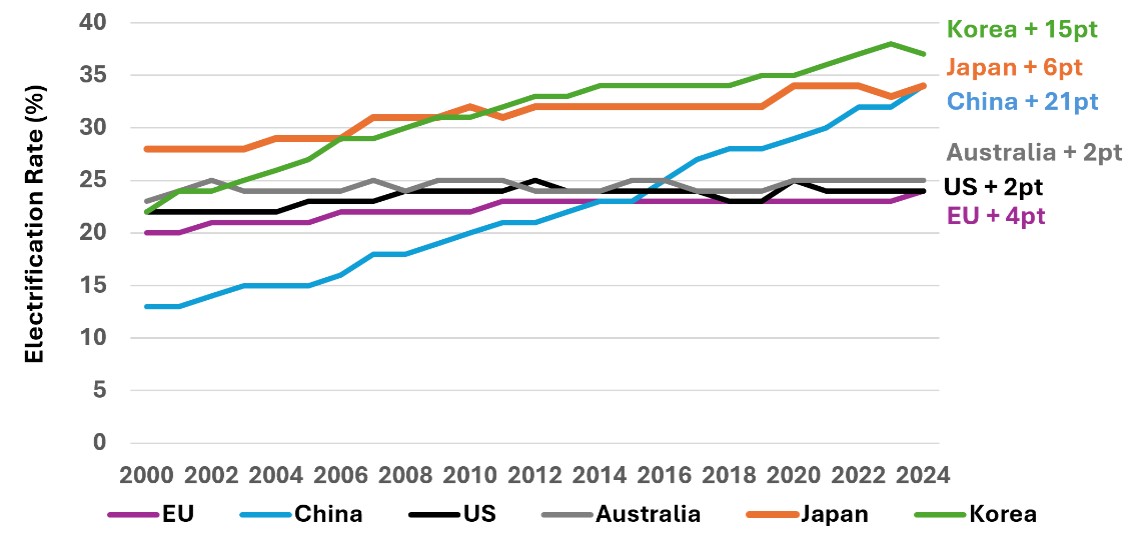
According to IEA data, Japan’s electrification rate stood at 36% in 2025, a relatively high level compared with other major countries.2 Looking at trends since 2000, South Korea and China have rapidly increased their electrification rates and have now reached levels comparable to Japan, while little growth has been observed in Europe and the United States.3 Japan’s electrification rate is already above 35%, the level proposed as the global target for 2035, and Japan is expected to play a leading role in driving further electrification worldwide.
Figure 1: Electrification rates in selected countries (2025), the EU-27 and the world (2023)
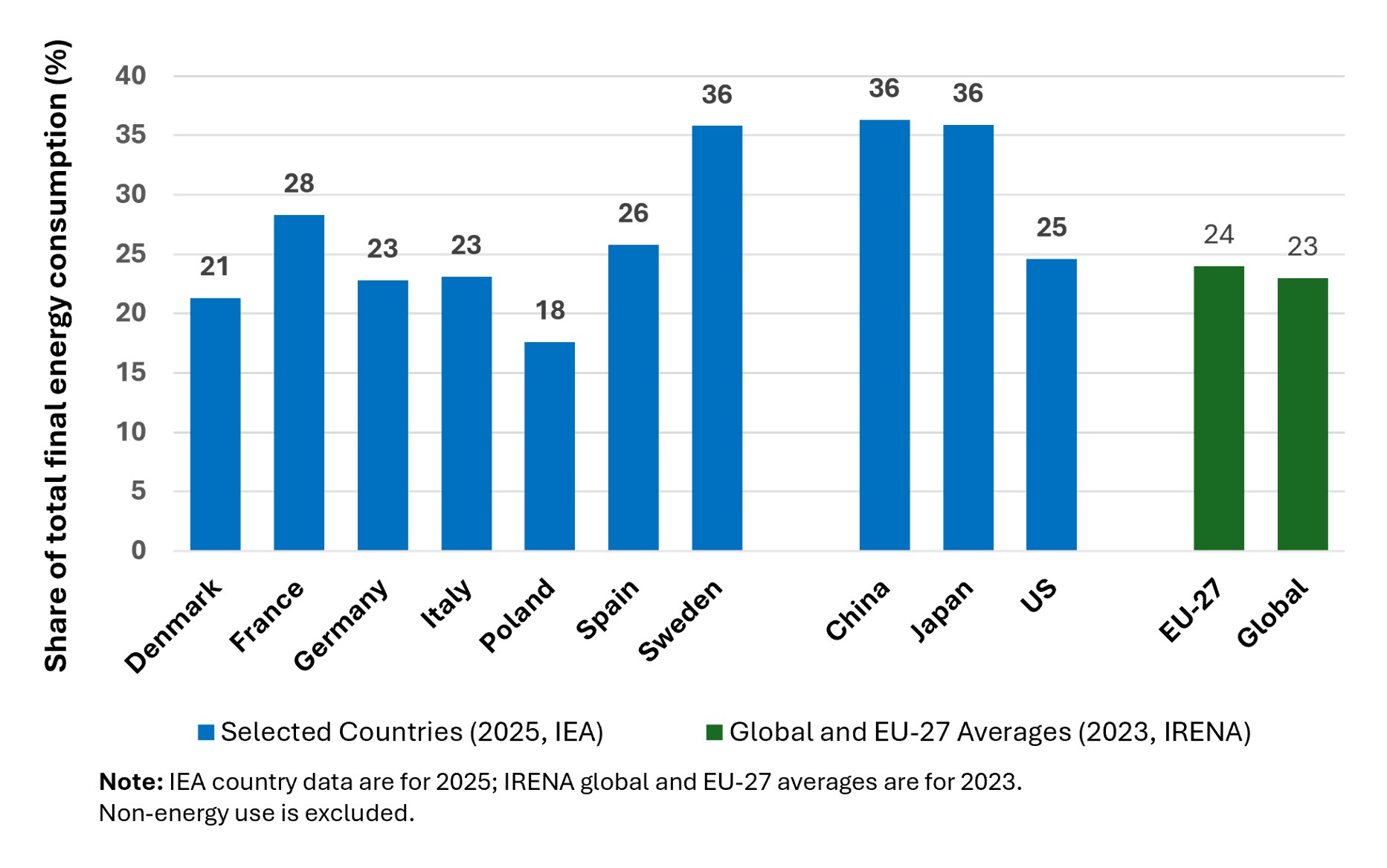
Figure 2: Trends in electrification rates, 2000-2024
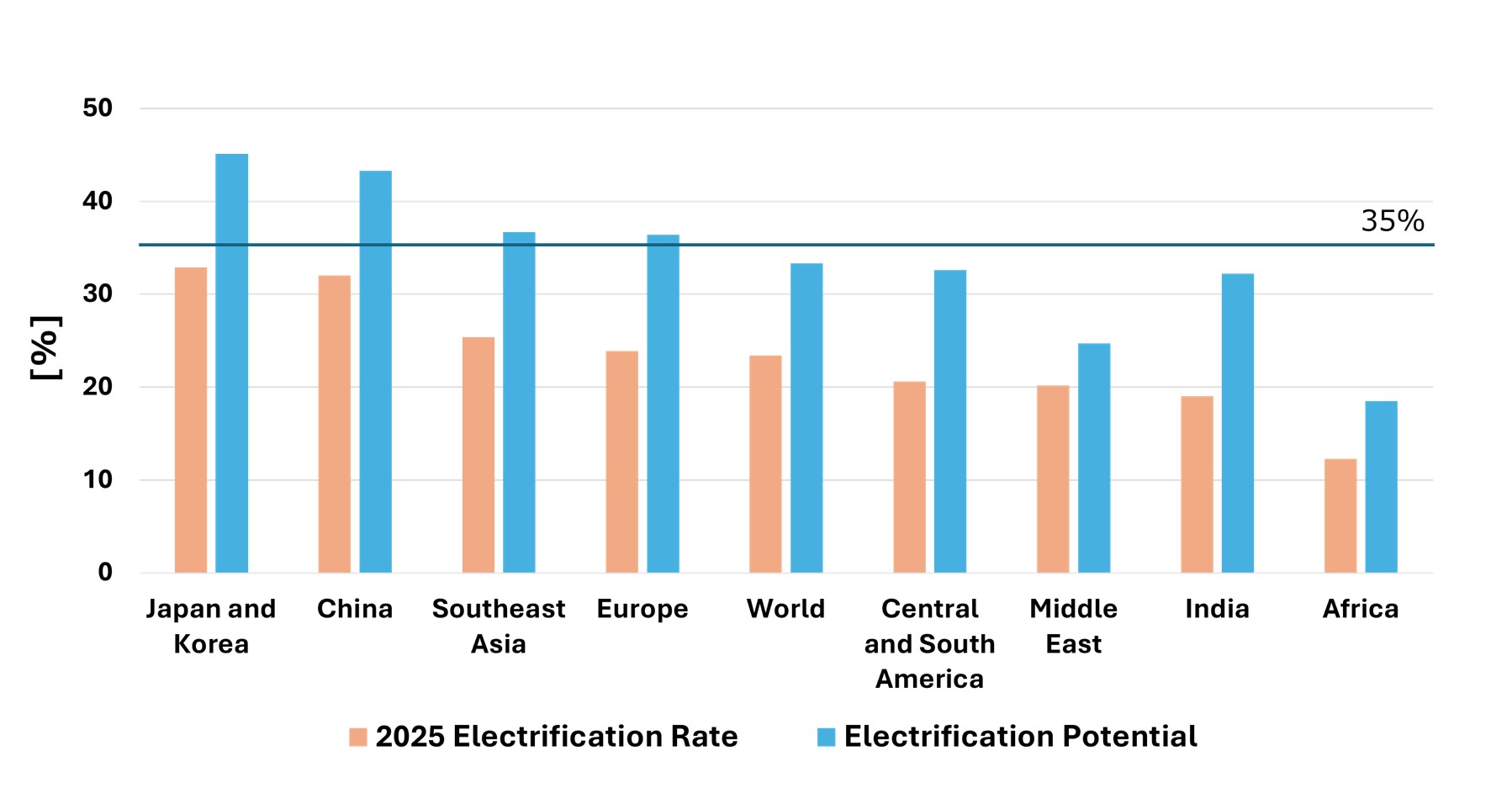
In addition, the IEA special report Electrification shows in its analysis by region, that if currently cost-competitive electrification technologies were deployed to their full potential, the electrification rate in the Japan–Korea region would rise well above the global target of 35%, indicating substantial potential for the region to lead global electrification.4
Figure 3: Cost-competitive electrification potential by major region
3. Recent Developments in Electrification Policies Worldwide
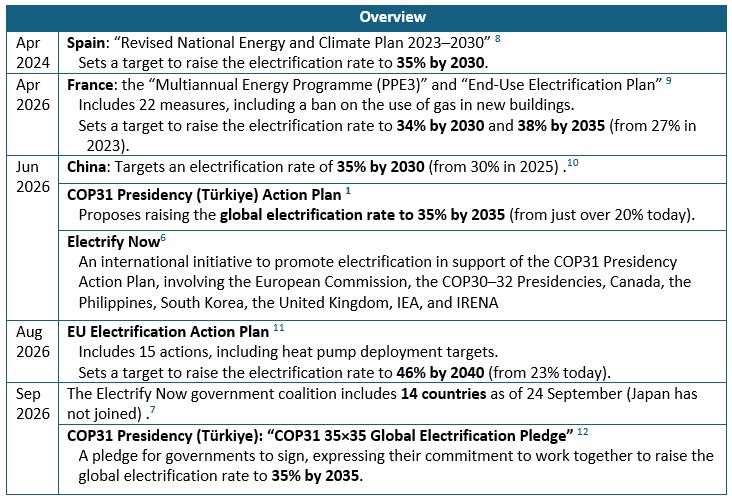
Spain, France, China, and the EU have established electrification targets or plans. In particular, the EU and France have identified the crisis in the Middle East as a renewed reminder of the risks associated with fossil fuel dependence.5
Alongside the COP31 Presidency’s proposal for a global electrification target, the European Commission, COP Presidencies, and other partners launched the international “Electrify Now” initiative to advance the 35% electrification target.6 In addition, the European Commission launched the Electrify Now government coalition, which currently includes Armenia, Australia, Brazil, Canada, Ethiopia, Germany, Jordan, Kenya, the Philippines, South Korea, Singapore, Türkiye, the United Kingdom, and Uruguay (as confirmed on the European Commission website on 24 September 2026).7
Table 1: COP31 and global electrification policies
4. Benefits of Electrification
Electrification refers to replacing heat and motive power produced through the combustion of fossil fuels with electricity. Electric technologies, including heat pumps, are generally more energy-efficient than combustion-based equipment and can therefore reduce fossil fuel consumption even when the electricity they use is generated from fossil fuels.13 As the share of renewable electricity increases, these reductions become even greater, further accelerating decarbonization. In addition, because renewable energy is domestically available, greater use of renewable electricity can also improve Japan’s energy self-sufficiency.
Electrification can also provide cost benefits. An estimate comparing the replacement of a residential gas water heater with a heat pump water heater found that, although the upfront cost of the heat pump system is higher, its greater energy efficiency reduces operating costs, resulting in an overall cost advantage even after the higher initial investment is taken into account.14 Based on these considerations, advancing electrification can be expected to provide the following benefits.
|
5. Heat Use in Japan’s Final Energy Consumption and Challenges for Electrification
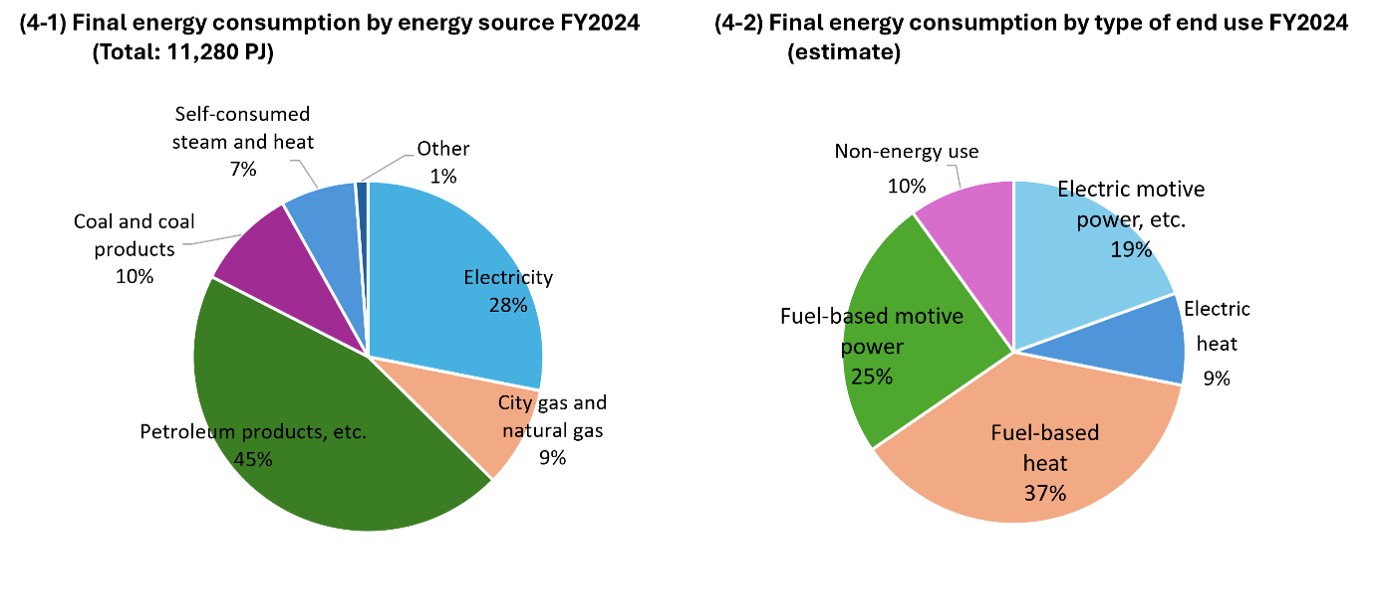
According to the Agency for Natural Resources and Energy, electricity accounts for 28% of Japan’s final energy consumption in FY2024,15 representing the country’s official electrification rate. This differs from the IEA electrification rate shown in Figure 1 because the two are calculated using different methodologies. In either case, Japan’s electrification rate can be considered comparatively high. It should also be noted that the final energy consumption figures published by the Agency for Natural Resources and Energy include non-energy use, such as feedstocks; excluding non-energy use raises the electrification rate to 31%.16
When final energy consumption is classified by type of end use, such as heat and motive power, heat accounts for 46% of the total (estimated by Renewable Energy Institute, as no official data are available for electrified heat).17 In other words, just under half of Japan’s final energy consumption is used as heat. Of total final energy consumption, electrified heat accounts for 9%, while heat produced through fossil fuel combustion accounts for 37%. In other words, around 80% of all heat use (approximately 4,200 PJ) still relies on fossil fuel combustion. Around 80% of this fossil-fuel-based heat is used at low and medium temperatures below 200°C,18 a temperature range that can be served by heat pumps, highlighting the need to accelerate electrification in this area.
Figure 4: Breakdown of Japan’s final energy consumption in FY2024
At the same time, further deployment of heat pumps faces a number of challenges:
- High upfront investment costs
- Space requirements for equipment installation
- Lock-in to fossil fuel-based equipment
- Shortages of engineering expertise and organizational capacity for industrial heat pumps
Lock-in to fossil fuel-based equipment can arise for several reasons, including customer retention by energy suppliers and other service providers, the need for immediate replacement when existing equipment fails, and the selection of heat sources based on existing systems without sufficient economic and technical assessment of alternative options.
6. Encourage Proactive Investment Through Predictability
As shown by the comparison of electrification rates worldwide, Japan already has a relatively high electrification rate, but there remains considerable scope for further electrification. At the same time, as discussed above, a number of challenges persist: demand for switching away from fossil fuel-based heat sources remains limited, and much of the heat pump supply side is focused primarily on meeting replacement demand for existing equipment. As a result, businesses have little basis for making proactive investments or building the organizational capacity needed to support a transition away from fossil fuel-based systems. On the demand side as well, heat users have few incentives to pursue electrification, limiting opportunities for solutions to be developed that would address the barriers to electrification.
While this proposal focuses primarily on the electrification of heat, another major challenge for electrification in Japan is the electrification of motive power. In particular, Japan continues to lag behind other major markets in the adoption of electric vehicles. In 2025, EVs (BEVs and PHEVs) accounted for less than 3% of new passenger vehicle sales in Japan, compared with around 25% globally, 53% in China, 27% in the EU, and 10% in the United States, highlighting the significant gap between Japan and other major markets.19
Accelerating electrification in Japan will require a shared understanding of both the significance of electrification and the goals to be achieved, making an ambitious national electrification target and clear policies for achieving it essential. In particular, setting heat pump deployment targets and introducing incentives to achieve them would help stimulate demand for electrification, increase the predictability needed to encourage proactive corporate investment, and ultimately contribute to strengthening Japan’s industrial competitiveness.
- UN Climate Change website, “COP31 Presidency announces new targets on global electrification, cutting waste, resilient cities; press conference transcript (2026/06/09)”, accessed 2026/09/18; Renewable Energy Institute Karolin Jiptner “2026, A New Push for Electrification: The EU Electrification Action Plan and Lessons for Japan 2026/08/26”
- IEA (2026), “Share of electricity in total final energy consumption and weighted average electricity/gas price ratio by country 2025”, IEA. Licence: CC BY 4.0, accessed 2026/09/25; IRENA “Transitioning away from fossil fuels: A roadmap based on renewables, electrification and grid enhancement 2026/05”, accessed 2026/09/25
- IEA (2026), “Economy-wide electrification rate in selected regions, 2000-2024”, IEA. Licence: CC BY 4.0, accessed 2026/09/25
- IEA (2026), “Electrification Special Report”, IEA. Licence: CC BY 4.0, accessed 2026/09/25
- Government of France website, “Présentation du plan d’électrification des usages 2026/04/23”, accessed 2026/09/19, EU EUR-Lex “ELECTRIFICATION ACTION PLAN 2026/07/17”, accessed 2026/09/19
- European Commission website, “Government’s Joint Statement on the launch of Electrify Now 2026/06/23”, accessed 2026/09/19; COP31 TURKiYE ANTALYA website “Governments launch ‘Electrify Now’ to accelerate the electrification of the global economy 2026/06/23”, accessed 2026/09/24
- European Commission website, “Electrify Now – a global initiative”, accessed 2026/09/24
- Spanish Ministry for the Ecological Transition and the Demographic Challenge (MITECO) website, “El Gobierno aprueba la actualización del Plan Nacional Integrado de Energía y Clima 2023–2030 2024/09/24”, accessed 2026/09/18
- Government of France websites, “PPE 3 : programmation pluriannuelle de l'énergie”, “Présentation du plan d’électrification des usages”, “PROGRAMMATION PLURIANNUELLE DE L’ÉNERGIE(2026-2035)”, accessed 2026/09/19
- Carbon Brief website, “Six charts show how clean power was world’s largest source of new energy in 2025 (2026/06/30)”, accessed 2026/09/24
- EU EUR-Lex, “ELECTRIFICATION ACTION PLAN 2026/07/17”, accessed 2026/09/19; Renewable Energy Institute Karolin Jiptner “2026, A New Push for Electrification: The EU Electrification Action Plan and Lessons for Japan 2026/08/26”
- COP31TURKiYE ANTALYA website, “COP31 35-by-35 Global Electrification Pledge 2026/09/21”, accessed 2026/09/24
- Heat pumps generally have an energy efficiency of 3 or more. Assuming a power generation efficiency of 40%, 2.5 units of fossil fuel energy are required to produce 3 units of heat. By contrast, boiler efficiency is below 1; assuming an efficiency of 0.9, 3.3 units of fossil fuel energy are required to produce the same 3 units of heat. Heat pumps therefore require less fossil fuel input to produce the same amount of heat.
- Calculation by Renewable Energy Institute. Electricity and gas prices are based on the Electricity Market Report (FY2025, Tokyo area) and the Gas Market Report (FY2025, Kanto area) published by the Electricity and Gas Market Surveillance Commission, and include the renewable energy surcharge. Equipment costs are based on a July 2026 survey of publicly available installation prices, including installation costs, for heat pump water heaters and gas water heaters. Energy efficiency assumptions were set with reference to the Top Runner Program standards.
- Agency for Natural Resources and Energy website, “エネルギー動向(2026年度)第1章第1節 3.エネルギー供給の動向【第11-3-3】電力化率の推移”, accessed 2026/09/19
- Calculation by Renewable Energy Institute based on the Agency for Natural Resources and Energy, “総合エネルギー統計(エネルギーバランス表)2024年度”
- Estimated by Renewable Energy Institute based on the Agency for Natural Resources and Energy “ 総合エネルギー統計 (エネルギーバランス表)2024年度”, and “エネルギー動向(2026年版)第1章第2節部門別エネルギー消費の動向”; the Ministry of Economy, Trade and Industry “ 総合資源エネルギー調査会 次世代エネルギー需給構造小委2022.4.14 (資料1)クリーンエネルギー戦略の策定に向けた検討①(参考)産業部門における熱利用の特徴”; and other sources.
- Based on the estimate in note 17 above, this number was calculated using heat generated from fossil fuel combustion in the residential and commercial sectors and heat used in the industrial sector at temperatures below 200°C, which was assumed to account for approximately 40% of industrial heat use. For the industrial sector, the calculation also takes into account final energy consumption classified as “heat” (steam) in manufacturing in the “Comprehensive Energy Statistics (Energy Balance Tables), FY2024” (総合エネルギー統計(エネルギーバランス表)2024年度), among other data.
- IEA (2026), “Global EV Outlook 2026, Trends in electric cars”, IEA. Licence: CC BY 4.0, accessed 2026/10/05
<Special Contents>
Electrification and Decarbonization of Heat