

In June 2026, a series of international developments brought electrification into sharper policy focus. On 9 June, the incoming COP31 Presidency proposed increasing the share of electricity in global final energy consumption from just over 20% today to 35% by 2035.1 Two weeks later, on 23 June, governments, businesses and international organizations launched the Electrify Now initiative in London.2 Then, on 17 July, the European Commission published its Electrification Action Plan, setting out an indicative objective of raising the EU electrification rate to 46% by 2040.3
Until recently, energy-transition policy has placed strong emphasis on expanding electricity supply from renewable sources. However, reducing fossil-fuel use requires not only decarbonizing the supply side, but also electrifying final energy demand in buildings, transport and industry. Electrification is also becoming increasingly important from an energy-security perspective, as it can reduce exposure to fossil-fuel price volatility and supply disruptions. Taken together, the developments of 2026 show that electrification is beginning to be treated as an explicit policy objective.
This column examines how this new international agenda is taking shape, focusing in particular on how the EU is translating a higher electrification target into concrete policy measures, and considers what lessons this approach may hold for Japan.
1. Where we are now
Investment in electricity supply and electrification of end-use sectors already accounts for around half of global energy investment, prompting the International Energy Agency (IEA) to describe the present period as the “Age of Electricity.”4 Across the global energy system, electricity is playing an increasingly important role, driven by developments in areas such as electric vehicles, heat pumps, data centers, manufacturing and heat applications.
Yet electricity still supplies less than one-quarter of global final energy consumption. According to IRENA, electricity accounted for approximately 23% of global total final energy consumption (TFEC) in 2023.
Figure 1: Electricity share of TFEC in selected EU and non-EU economies
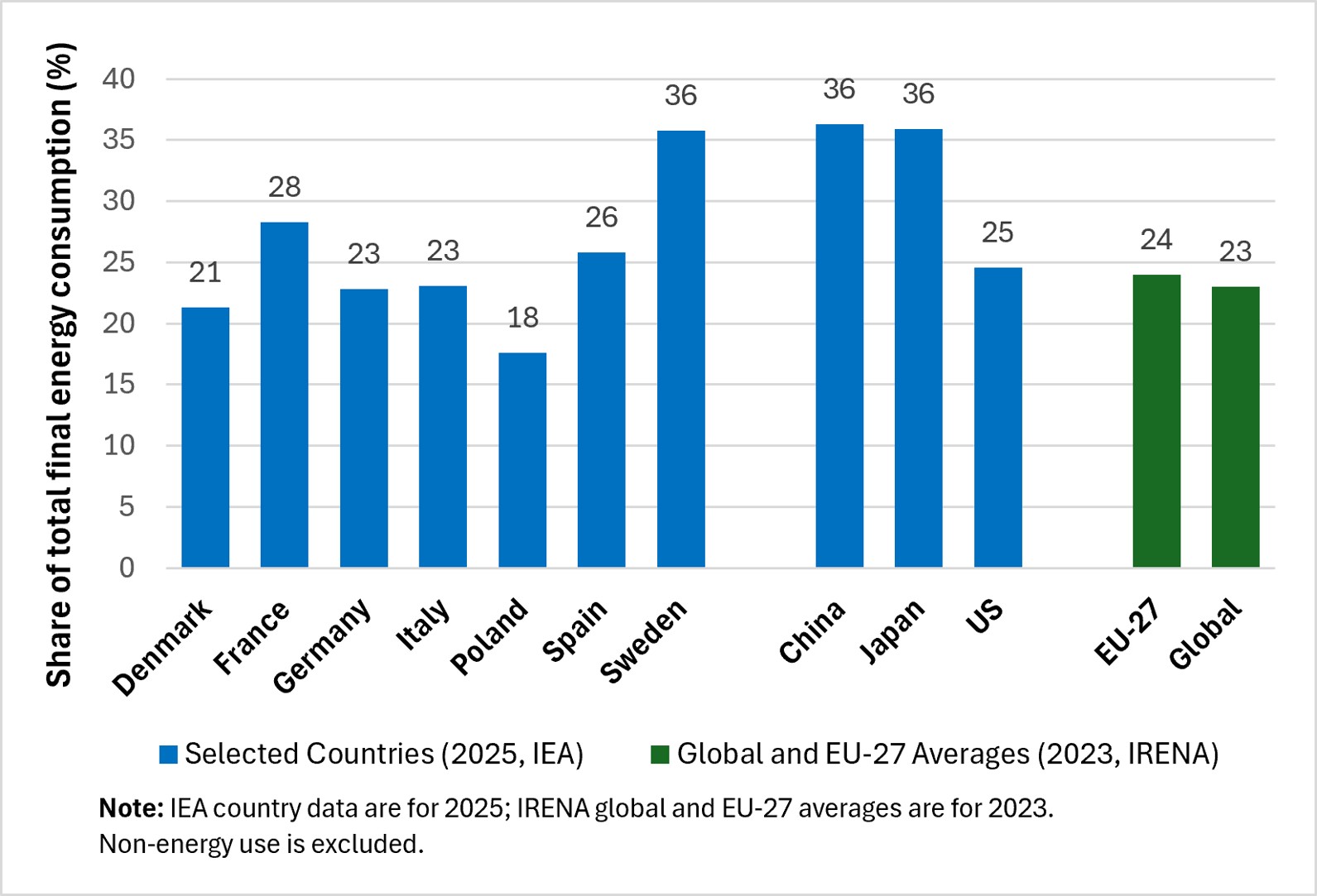
As Figure 1 shows, current electrification rates vary considerably across countries, reflecting differences in industrial structures, transport systems, and historical patterns of electricity use for heating and cooling. They say nothing about whether the electricity itself comes from renewable, nuclear or fossil-fuel sources. Expanding renewable power generation alone does not replace oil and gas in buildings, vehicles and factories. For example, despite substantial expansion of renewable electricity, the EU’s electrification rate remains below 25% and has changed little over the past decade. Further decarbonization therefore requires not only more renewable electricity, but also replacing fossil fuels in buildings, industry and transport.
Despite the growing importance of electricity, explicit national electrification targets have been relatively rare. Spain was an early exception. Its updated National Energy and Climate Plan PNIEC 2023 aims to raise the electrification rate to 35% by 2030.7 China also set a target of approximately 30% by 2025, which it reports having achieved. In June 2026, China extended this approach by adopting a new target of 35% by 2030.8 In France, the government presented a national electrification plan in April 2026 under which electricity’s share of final energy consumption rises from 27% in 2023 to 34% in 2030 and 38% in 2035.9,10 The COP31 Presidency’s 35% by 2035 announcement may create momentum for further national electrification targets in the near future.
Note: National electrification rates are not always directly comparable because of differences in statistical definitions and accounting systems. Figure 1 uses the IEA definition of total final energy consumption (TFEC), which excludes non-energy uses of fuels. The Spanish and French targets similarly exclude non-energy uses and are therefore broadly comparable, although some differences in national statistical treatment remain. China, by contrast, uses a broader definition of final energy consumption in its national energy statistics, which may include energy used as raw materials. As a result, China reports an electrification rate of 30% in 2025, while the IEA TFEC-based data shown in Figure 1 indicate a substantially higher share of around 36%. For Japan as well, the officially reported electrification rate of 28.1% in FY202411 uses final energy consumption including non-energy uses as the denominator and is therefore not directly comparable with the IEA figure of around 36% shown in Figure 1.
2. “35% by 2035”: a new global reference point
On 9 June 2026, the incoming COP31 Presidency of Türkiye proposed a new global objective: increase the share of final energy demand met by electricity from just over 20% today to 35% by 2035. The target forms part of the COP31 Global Climate Action Agenda and draws on analysis by IRENA and the IEA.
The 35% objective closely follows IRENA’s revised 1.5°C pathway 2026, under which electricity rises from around 23% of global final energy consumption in 2023 to 35% in 2035 and more than 50% by 2050. Reaching 35% requires substantial changes in all three major end-use sectors as shown in Figure 2. Transport requires the most dramatic transformation from a very low starting point, while buildings show the largest percentage-point increase in electrification by 2035.
Figure 2: Sector specific global electrification pathway under IRENA’s 1.5°C scenario
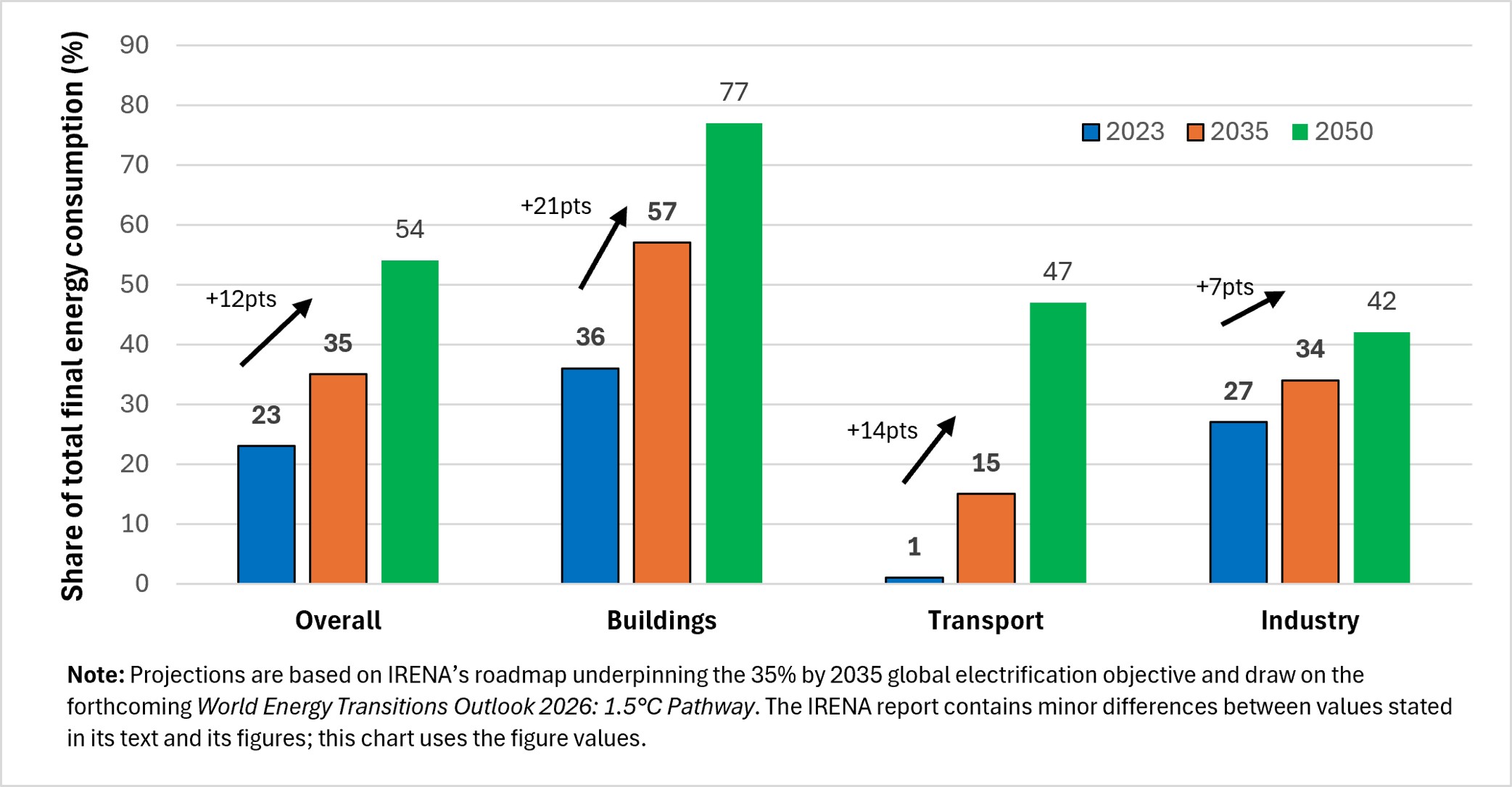
The different sectoral pathways illustrate why the new objective represents a shift in emphasis. International clean-energy commitments have so far concentrated heavily on the supply side, notably the COP28 agreement to triple renewable-power capacity and double the rate of energy-efficiency improvement by 2030.12 The 35% objective adds a stronger demand-side dimension: producing more renewable electricity alone will not eliminate fossil-fuel consumption unless vehicles, heating systems and industrial processes are also converted to electricity.
It should be noted that the 35% objective is not yet a negotiated or legally binding COP target. It is part of the Presidency-led Global Climate Action Agenda, which operates alongside the formal negotiations and is intended to mobilize governments, businesses, investors and civil society around implementation.
Electrify Now: turning the target into action
Electrify Now was launched at the London Climate Action Week 2026 to build international support around the 35% objective. The initiative was launched jointly by the European Commission, the COP30 Presidency of Brazil, the COP31 Presidency of Türkiye and Australia, the incoming COP32 Presidency of Ethiopia, Canada, the Philippines, the Republic of Korea, the United Kingdom, the IEA and IRENA. It is also supported by businesses, financial institutions and more than 40 organizations and alliances, and is open to additional partners.
The initiative responds not only to climate change, but also to energy-security concerns, fossil-fuel price volatility and supply disruptions. Electrify Now aims to turn the global ambition into implementation by encouraging governments to develop national and subnational electrification plans, while simultaneously accelerating clean-power generation, grid modernization and storage. It also seeks to spread replicable policies and projects, strengthen supply chains and mobilize public and private investment, particularly in emerging and developing economies.
3. The EU’s Electrification Action Plan: designing an electrified economy
As stated in the Electrification Action Plan, the EU obtains around 70% of its electricity from domestic clean sources, yet electricity has remained at approximately 23% of final energy consumption for a decade.13 The Commission therefore argues that progress in clean power and energy efficiency will reach a ceiling unless fossil-fuel demand in buildings, transport and industry is replaced by electricity.
The Electrification Action Plan introduces an indicative objective of raising electrification to 46% by 2040. Commission modeling indicates that an accelerated energy transition with electrification at its core could by 2040 deliver substantial benefits:
- More than 70% reduction in gas imports by 2040.
- More than 40% reduction in crude-oil imports.
- Savings of up to €260 billion per year in reduced fossil-fuel import costs by 2040.
- Electricity generation costs approximately 20% lower.
- Greater investment certainty for European clean-tech manufacturing and services, supporting future-proof jobs across the EU.
- More than 2 billion tons of CO₂ reductions in 2040 compared with today.
The most significant feature of the Plan is its recognition that electrification will not occur automatically. It requires coordinated changes in electricity pricing, finance, infrastructure, technology deployment, industrial capacity and skills. The Plan translates this approach into 15 actions, summarized below following the main barriers they are intended to address.
3.1 Establish a common direction: 46% by 2040 (Action 1)
The first action establishes a common reference point for the transition: electricity should account for 46% of EU final energy consumption by 2040. The objective is indicative rather than binding and will be subject to an impact assessment by the Commission as part of the “Energy Union Package for the Decade Ahead”, expected in Q4 2026.14
Table 1: Summary of Action 1

A common EU-wide objective is intended to provide a clearer long-term market signal. Greater certainty over the direction of electrification can strengthen investment cases for European clean-tech manufacturing and services, support the expansion of associated value chains and create future-proof jobs.
Action 1 provides the destination; the remaining 14 actions address the economic, infrastructure and implementation constraints that currently prevent the EU from reaching it.
3.2 Reduce the cost disadvantage of electricity (Actions 2~5)
The Commission identifies the relative price of electricity and fossil fuels as one of the most immediate barriers to electrification. It states that electricity prices for households and industry are in many cases significantly higher than those for fossil fuels and in only two Member States, Finland and Sweden, is electricity less than twice as expensive as gas.15 The disparity is not determined by generation costs alone: network charges, taxes and levies, as well as continued fossil-fuel subsidies, all affect the relative economics of switching to electric technologies.
The consequences are already visible in technology uptake. Member States with the lowest electricity-to-gas price ratios record around three times as many heat-pump sales as countries where the ratio exceeds three. The Commission therefore encourages Member States to bring the ratio down to no more than 2.5 for households and 2 for industry by 2030. These levels are key performance indicators (KPIs), intended to monitor progress rather than impose binding national requirements.
Table 2: Summary of Actions 2-5
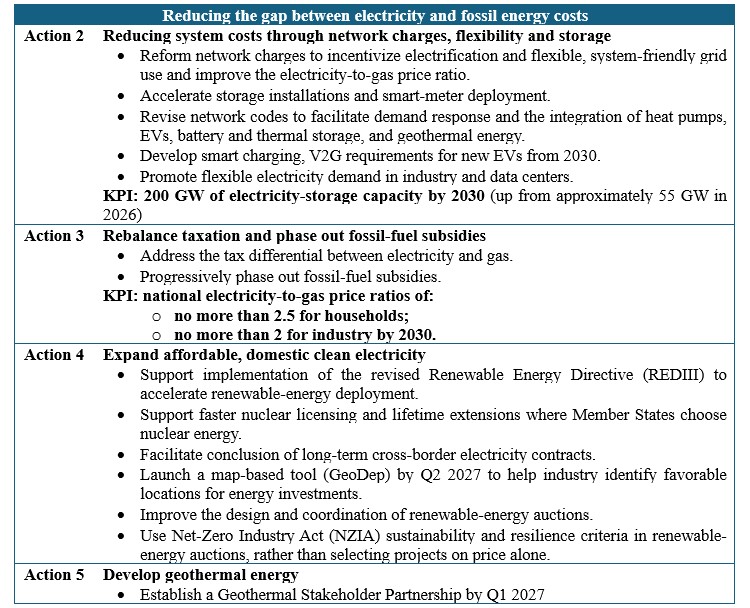
Actions 2–5 address the cost gap from both the demand and supply sides. Network-charge and tax reforms are intended to improve the economics of electrification directly, while phasing out fossil-fuel subsidies would remove incentives that artificially favor continued fossil-fuel use. At the same time, expanding domestic clean generation and facilitating long-term electricity contracts are intended to reduce exposure to volatile fossil-fuel prices.
Importantly, Action 2 links affordability to a flexible energy system: storage, smart meters, demand response, thermal storage and vehicle-to-grid applications are intended to make better use of existing networks and allow new electric demand to respond to periods of abundant and cheaper electricity.
3.3 Lower upfront costs and accelerate adoption in end-use sectors (Actions 6~9)
Even where electric technologies have lower operating costs, the initial investment required to replace fossil-fuel equipment can slow adoption. The Commission therefore treats upfront technical, administrative and financial costs as a separate barrier. Its approach combines fiscal incentives and financing support with sector-specific measures for industry, transport and buildings. The Emissions Trading System 2 (ETS2)16 and the Social Climate Fund are also expected to support this transition.
Table 3: Summary of Actions 6-9
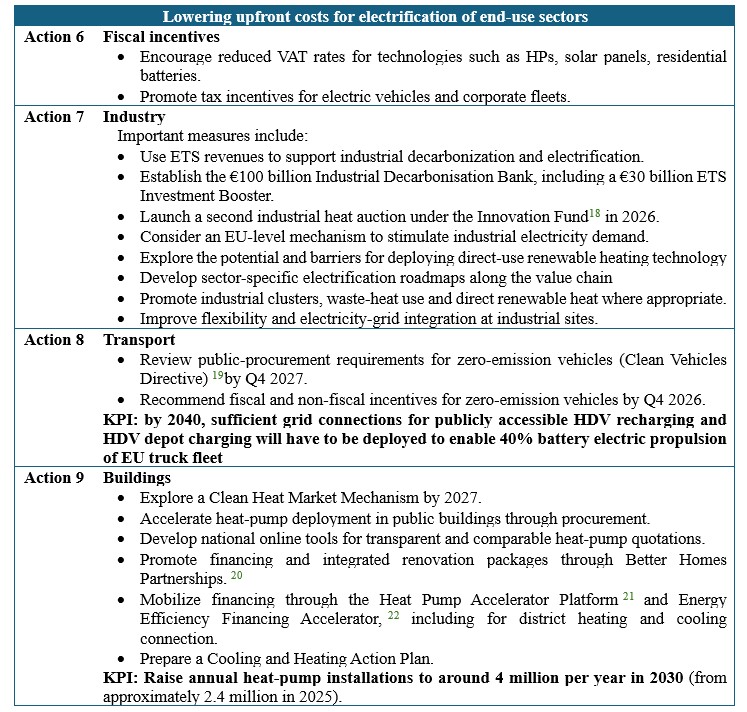
The scale and nature of the challenge differ considerably between sectors. In industry, the Commission estimates that around 60% of fuel-based energy demand is already technically electrifiable, particularly through technologies such as industrial heat pumps, electric boilers and electric furnaces. Road transport, meanwhile, accounts for almost one-third of EU energy consumption, yet battery-electric vehicles (BEV) still make up only 2.9% of the passenger-car fleet. Buildings account for around half of EU gas consumption, making the replacement of fossil heating particularly important. To accelerate adoption, Actions 6–9 combine tax incentives and financing, support for large industrial investments, public procurement and demand-side incentives, and measures intended to create stronger markets for technologies such as electric vehicles and heat pumps.
3.4 Provide the infrastructure required by electrification (Actions 10~11)
The Commission identifies insufficient grid capacity, long connection queues and delays in grid expansion as another structural constraint on electrification. Its response builds partly on measures already proposed under the EU Grids Package,23 while calling for stronger coordination between network planning and future electricity users, including industrial sites, data centers, district-heating operators, charging-point operators, airports and ports. The European Investment Bank (EIB) also intends to provide more than €75 billion over three years for clean-energy investment, with grids among the priorities.
Actions 10 and 11 focus particularly on the infrastructure needed to connect transport and heating to this increasingly electrified energy system.
Table 4: Summary of Actions 10-11
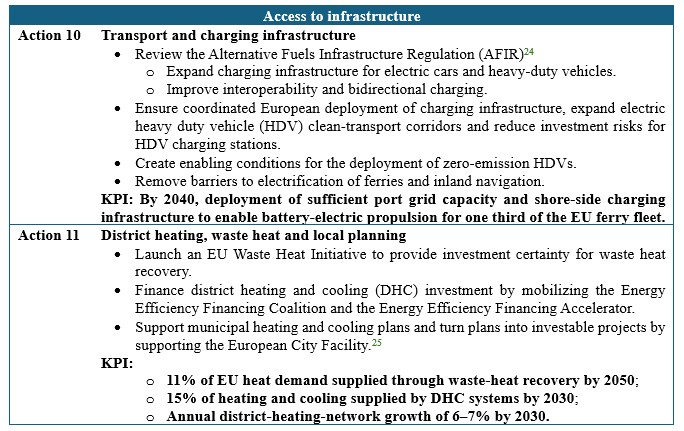
In transport, the priority is increasingly shifting from electric vehicles themselves to ensuring that charging and grid infrastructure can support their deployment at scale.
District heating and cooling systems can integrate large heat pumps and electric boilers with thermal storage, while also making use of geothermal, solar thermal and waste heat. The Commission argues that such systems can provide flexibility and reduce pressure on the electricity grid.
3.5 Accelerating innovation in electrification solutions (Action 12)
The Commission notes that most current fossil fuel consumption can already be electrified, but some applications still require further innovation, particularly certain industrial processes and long-distance transport. The EU already commits €18.6 billion to electrification-related technology development through Horizon Europe,26 the Modernisation Fund27 and the Innovation Fund18. Horizon Europe alone allocates almost €2 billion for 2026–2027 to areas including storage, grids, buildings, industry, heating and cooling, and transport.
Table 5: Summary of Action 12
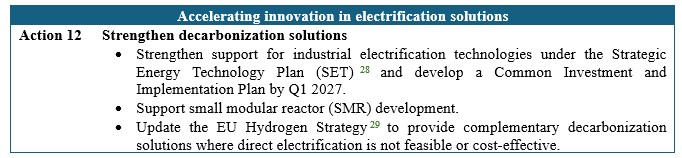
Action 12 focuses particularly on industrial applications, however the Commission also highlights digitalization, data sharing and AI as enablers of demand flexibility.
3.6 Aligning value chains with the target (Actions 13~14)
Scaling electrification will require a corresponding expansion of workforce and clean-technology supply chains. The Commission projects the energy-sector workforce to grow by around 50% by 2030. Skills shortages are already emerging in several areas: for heat pumps alone, the IEA estimates that the EU would need around 500,000 skilled workers, compared with approximately 165,000 in 2024, to meet its deployment ambitions.30 Differences in certification and qualification systems between Member States can further restrict the mobility of installers and other skilled workers across the EU.
Table 6: Summary of Actions 13-14
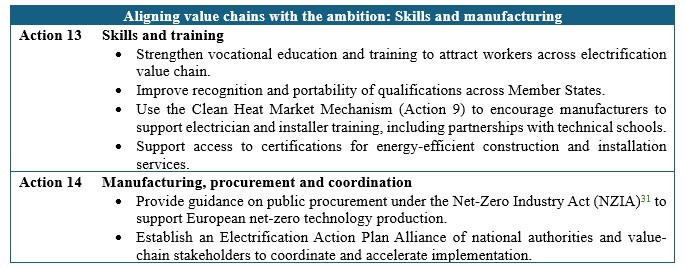
The underlying objective is to ensure that rapidly growing demand for electrification does not run into shortages of installers, skilled workers or technology supply and that the resulting market growth also strengthens European industrial capacity.
3.7 Promote clean electrification internationally (Action 15)
The final action extends the EU’s electrification agenda beyond its own borders.
Table 7: Summary of Action 15

The international dimension also serves an economic objective. The Commission argues that faster global electrification can expand markets for European technologies and standards, while larger global markets can accelerate manufacturing scale-up and further reduce clean-technology costs.
3.8 Implementation requires cross-sectoral approaches
The structure of the Action Plan reflects the Commission’s assessment that five main barriers are holding back electrification: the relative cost of electricity, high upfront investment costs, insufficient infrastructure, slow uptake of innovation, and constraints in skills and manufacturing. Progress in one area depends on the others: for example, lower equipment costs will have limited impact if electricity remains expensive or grid connections and skilled installers are unavailable.
The key feature of the Plan is therefore not simply the 46% objective, but the attempt to address the conditions required to make that objective achievable. Many of these measures, however, still depend on subsequent EU legislation or implementation by Member States.
Example: Building sector electrification
Action 9 contains the Plan’s dedicated measures for buildings and heat pumps, including a KPI to raise annual heat-pump installations from around 2.4 million in 2025 to 4 million by 2030. The Commission’s approach makes clear that deployment depends on measures spread across the Action Plan, from electricity prices and financing to grids, skills and manufacturing as summarized in Figure 3.
Figure 3: Electrification depends on measures across the Electrification Action Plan
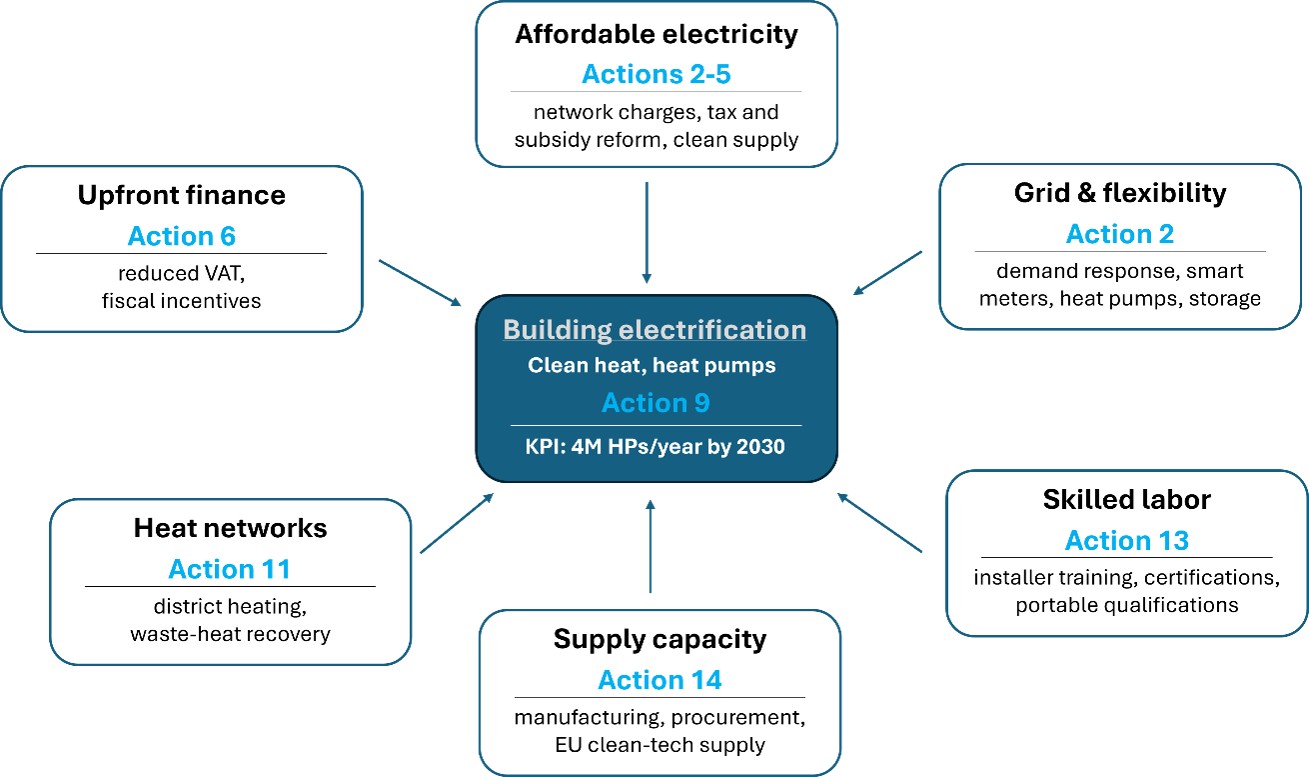
Source: Created by Renewable Energy Institute.
4. Implications for Japan
Japan and the EU differ in their building stocks, heating practices, electricity systems and starting levels of electrification. Although the figures vary depending on statistical definitions, Japan’s electrification rate is comparatively high by international standards (see Section 1). However, the global objective of “35% by 2035” is intended to raise the electrification rate of the world as a whole and Japan’s relatively high electrification rate does not mean that there is little scope for further electrification. Significant fossil-fuel demand remains in areas including:
- domestic hot water and space heating in cold regions;
- space heating and warm water in commercial buildings;
- industrial heat;
- transport.
Japan therefore needs to identify where direct and efficient electrification is technically and economically appropriate and steadily replace the remaining fossil-fuel demand in those areas. The following can be learned from the EU Electrification Action Plan:
Position energy security as a driver of electrification policy
As discussed in the first column in this series, recent moves toward electrification have been driven in important part by energy crises, fossil-fuel price volatility and the risk of supply disruptions. The EU Electrification Action Plan, as well as Electrify Now, identifies reduced fossil-fuel imports as an important benefit of accelerated electrification. Japan should similarly consider electrification not only as a decarbonization measure, but also as an energy-security strategy that can reduce exposure to fossil-fuel prices and supply risks.
Provide a clear direction and build markets to increase investment certainty
One purpose of the EU’s common 46% objective is to provide a long-term market signal on the direction of electrification and encourage investment in clean-technology manufacturing, services and related value chains. Indeed, the EU Electrification Action Plan explicitly links market expansion and greater investment certainty with strengthening the competitiveness of Europe’s clean-technology industries. In Japan, providing a clearer medium- to long-term direction for electrification and greater certainty about future market growth would help encourage corporate investment in equipment, manufacturing capacity, infrastructure and skills. Japan already has a globally competitive technological and industrial base in areas such as high-efficiency heat pumps and heat-pump water heaters using CO₂ refrigerants.32 Leveraging these domestic strengths and linking the expansion of electrification markets to stronger industrial competitiveness should also be an important consideration.
Pay attention to the relative price of electricity and fossil fuels
Of the five main barriers to electrification identified in the EU Electrification Action Plan, the price gap between electricity and fossil fuels is listed first and treated as an important issue to address. The Commission argues that the economics of switching to technologies such as heat pumps deteriorate significantly when electricity costs more than around two to two-and-a-half times as much as gas, and has set KPIs of reducing the electricity-to-gas price ratio to no more than 2.5 for households and 2 for industry by 2030. In other words, the existence of highly efficient technologies such as heat pumps does not mean that electrification will happen automatically. Japan’s energy-use patterns and tariff structures differ from those of the EU, nevertheless, policy should pay attention to the relative cost of electricity compared with competing fossil fuels and consider taxes, levies and subsidies as part of creating economic conditions in which electrification becomes an attractive choice.
Consider end-use electrification and the electricity system as an integrated whole
The EU approach emphasizes integrating demand response, smart meters, electricity and thermal storage, EVs and heat pumps into the power system so that electricity demand itself becomes more flexible. The objective is to make more efficient use of existing grids and shift demand toward periods when renewable electricity is abundant, thereby also reducing overall system costs. Japan should likewise pursue electrification as a cross-sectoral policy that connects new electricity demand, the expansion of renewable energy, grids, electricity and thermal storage, and demand-side flexibility, rather than considering these elements separately.
The developments of 2026 show that electrification is a strategic policy field linking energy security, electricity prices, power systems, investment and industrial competitiveness. Electrification therefore also has major strategic significance for Japan’s energy and industrial policies. Japan already has a comparatively high electrification rate and possesses the technological and industrial base to help drive electrification globally. As global electrification gathers momentum, Japan is can and should play an active role.
- United Nations Climate Change, news, “COP31 Presidency announces new targets on global electrification, cutting waste, resilient cities; press conference transcript” (2026/06/09), accessed 2026/08/06
- European Commission, webpage, “Electrify Now – a global initiative” (2026/06/23), accessed 2026/08/06
- European Commission, news article, “A plan to make Europe the first electro-continent” (2026/07/17), accessed 2026/08/06
- IEA, report, “Electricity 2026” (2026/02/06), accessed 2026/08/08
- IEA, dataset, “Share of electricity in total final energy consumption and weighted average electricity/gas price ratio by country, 2025”, accessed 2026/07/28
- IRENA, report, “Transitioning away from fossil fuels: A roadmap powered by renewables, electrification and grid enhancement”, accessed 2026/07/28
- Spanish Ministry for the Ecological Transition and the Demographic Challenge (MITECO), press release, “El Gobierno aprueba la actualización del Plan Nacional Integrado de Energía y Clima 2023–2030” (2024/09/24), accessed 2026/08/08
- Carbon Brief, publication, “Six charts show how clean power was world’s largest source of new energy in 2025” (2026/06/30), accessed 2026/08/08
- French Ministry of Economy, press release, “Présentation du plan d’électrification des usages” (2026/04/23), accessed 2026/08/08
- French Ministry of Economy, webpage, “PPE 3 : programmation pluriannuelle de l'énergie”, accessed 2026/08/08
- Agency for Natural Resources and Energy (Japan), report, “エネルギー動向(2026年版)”, accessed 2026/08/17
- United Nations, Decision 1/CMA.5 adopted at COP28 2023, “Outcome of the first global stocktake”, accessed 2026/08/18
- EUR-Lex, communication, “Communication from [...] and the committee of the regions electrification action plan” (2026/07/17), accessed 2026/08/10
- Energy Union Package for the Decade Ahead: A European Commission policy package planned for later in 2026, setting out the EU’s energy-policy framework beyond 2030, including the future frameworks for renewable energy and energy efficiency.
- Based on European Commission calculations using Eurostat data, as stated in the Electrification Action Plan.
- ETS2: Separate EU emissions trading system covering buildings, road transport and additional sectors. Full operation is scheduled from 2028.
- Social Climate Fund: EU fund supporting vulnerable households, transport users and micro-enterprises affected by ETS2, including through building renovation and clean heating measures.
- Innovation Fund: EU fund financed mainly by EU ETS revenues to support innovative low-carbon and net-zero technologies.
- Clean Vehicles Directive: EU directive promoting low- and zero-emission vehicles through public procurement.
- Better Homes Partnerships: EU initiative bringing together public and private actors to accelerate affordable, high-quality building renovation.
- Heat Pump Accelerator Platform: EU-wide platform bringing together stakeholders to identify barriers to heat-pump deployment and develop policy recommendations.
- Energy Efficiency Financing Accelerator: A financing initiative referenced in the 2026 Electrification Action Plan to help de-risk and finance investments in heat pumps, district heating and cooling, and related projects. It complements the European Energy Efficiency Financing Coalition, which works to mobilize private investment in energy efficiency.
- EU Grids Package: EU policy package adopted in December 2025 to strengthen and expand European energy grids, improve cross-border planning and accelerate permitting and grid connections.
- Alternative Fuels Infrastructure Regulation (AFIR): EU regulation setting mandatory targets for the deployment of alternative-fuel infrastructure, including EV charging and hydrogen refueling infrastructure.
- European City Facility (EUCF): EU initiative providing financial and technical support to cities and municipalities to turn sustainable-energy plans into concrete investment projects.
- Horizon Europe: The EU’s main research and innovation funding program for 2021–2027, with an indicative budget of €93.5 billion.
- Modernisation Fund: EU ETS-funded program supporting the modernization of energy systems and energy efficiency in 13 lower-income EU Member States.
- Strategic Energy Technology Plan (SET Plan): EU framework established in 2007 to coordinate research, innovation and market uptake of strategic clean-energy technologies across Europe.
- EU Hydrogen Strategy: EU strategy adopted in 2020 to support the development and deployment of clean hydrogen as part of the transition to climate neutrality.
- IEA, report, “World Energy Employment 2025”, accessed 2026/08/10
- Net-Zero Industry Act (NZIA): EU regulation adopted in 2024 to strengthen European manufacturing capacity for net-zero technologies and improve the resilience of clean-tech supply chains.
- IEA, report, “Heat Pump Monitor 2026”, accessed 2026/08/17
Series “The Overlooked Energy Transition: Electrification of the Heating Sector”
This column series aims to explore international trends in electrification policies, particularly those related to heat use, which are attracting growing attention from the perspectives of decarbonization and energy security. It also examines the challenges and potential of electrification in Japan, with the aim of developing policy recommendations.
No.1 From Energy Crisis to Electrification: Four Pillars of EU Policy (23 June 2026)
No.2 2026, A New Push for Electrification: The EU Electrification Action Plan and Lessons for Japan (26 August 2026)