


The full report is available in Japanese .
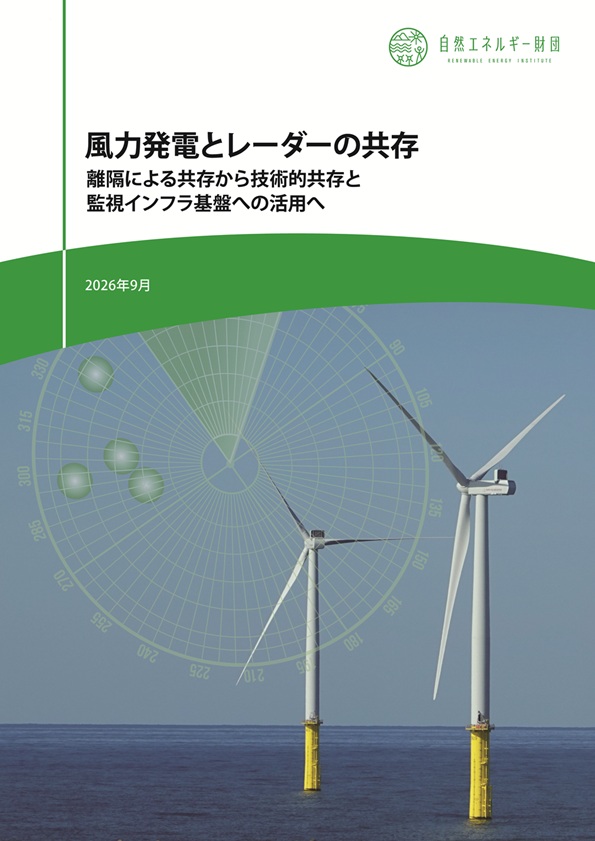
Renewable Energy Institute released a report entitled "Coexistence of Wind Power and Radar: From Separation-Based Avoidance to Technical Coexistence and Surveillance Platforms."
This report reviews and summarizes studies, research, and demonstration trials conducted primarily in Europe and the United States concerning radar interference caused by wind power facilities. It aims to describe specific technical mitigation measures and their implementation status, while identifying the challenges and potential solutions for achieving coexistence between wind power generation and various types of radar systems.
Steel towers and other structural components of wind turbines strongly reflect radar signals and can therefore generate clutter and other adverse effects on radar systems. In addition, wind turbine blades incorporate lightning receptors and conductors that carry lightning currents to grounding points. As the blades rotate, these components and the blades themselves produce Doppler components in the reflected radar signals, which may affect target detection, identification, and tracking.
When wind power deployment was relatively limited, coexistence with radar systems was generally achieved by maintaining adequate separation distances from radar installations and adjusting the siting and orientation of wind turbines. However, as the expansion of renewable energy has become increasingly important from the perspective of energy security, reconciling the further deployment of wind power with the reliable operation of radar systems for aviation, defense, meteorology, and other purposes has emerged as an important societal challenge.
Since the early 2010s, countries such as the United States and the United Kingdom have been addressing the effects of onshore wind farms on weather radar, airport surveillance radar, air traffic control radar, and other radar systems. Furthermore, with the large-scale deployment of offshore wind power also in view, studies, research programs, and demonstration trials have been conducted on radar interference mitigation measures. Based on the results of these efforts, the coexistence of wind power generation and various radar systems through technical mitigation measures is now moving toward practical implementation.
Executive Summary
1. Introduction
2. Technical Approaches to Wind–Radar Coexistence in Major Countries
2.1.2 Technical Coexistence Measures and Their Implementation Status
2.2.2 United Kingdom
2.2.3 Denmark
2.2.4 Poland
2.2.5 Netherlands
2.2.6 Germany
2.2.7 Taiwan
2.2.8 South Korea
2.2.9 Philippines
2.2.10 Australia
<Related Links>
[Special Contents] Wind