

Building electrification refers to replacing fossil fuel-based equipment with electric alternatives, primarily heat pumps for space heating, cooling, and hot water. Heating equipment typically needs to be replaced every 10 to 20 years, considerably sooner than the end of a building's lifespan. However, buildings are often designed on the assumption that existing equipment will be replaced with equipment of the same type. As a result, switching to heat pumps can present various challenges and constraints.
Consequently, buildings equipped with fossil fuel-based heating and cooling systems risk becoming subject to long-term carbon lock-in, perpetuating CO₂ emissions and making future decarbonization more difficult. The Intergovernmental Panel on Climate Change (IPCC) has warned that insufficient policy ambition can lock building emissions in for decades.1 To achieve decarbonization by mid-century, it is therefore critically important to install heat pumps in new buildings from the outset.
At a minimum, new buildings should be designed to accommodate future electrification, taking into account the expected replacement cycles of their heating and cooling equipment.
California is addressing these challenges through a combination of heat-pump deployment targets, cooperation with equipment manufacturers, building regulations, and financial and technical support. One noteworthy feature is its “electric-ready” requirements, which aim to preserve the possibility of switching to electric equipment even when buildings are not fully electrified from the outset. This column examines California’s broader approach to building electrification and related policies.
1. Electrification targets and coordinated action
California’s housing targets aim to increase the number of all-electric homes and homes prepared for future electrification. New York State similarly distinguishes between electrified homes and those prepared for future electrification, as summarized in Table 1.
Table 1: California and New York state targets concerning electrification of residential buildings
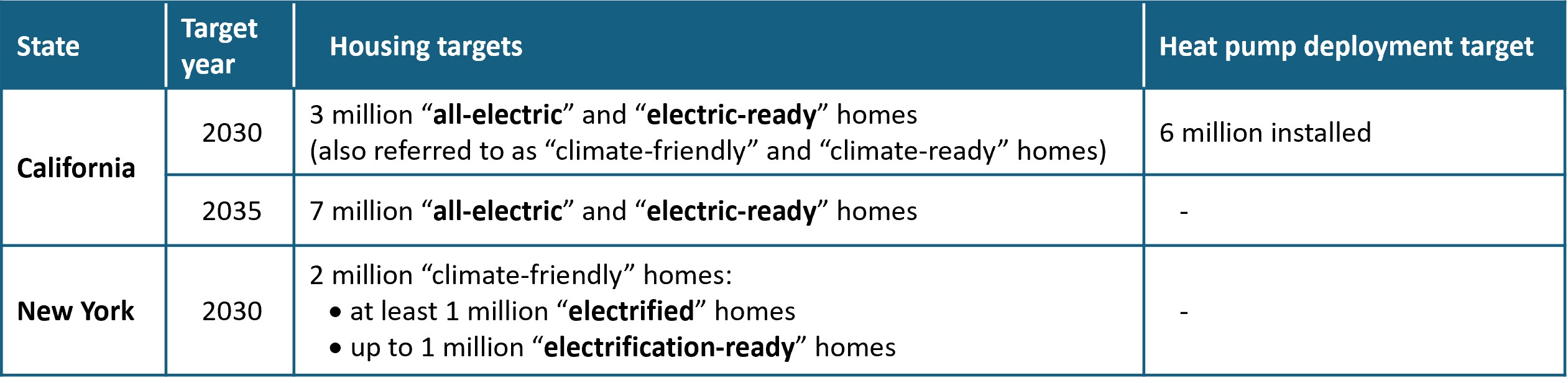
the state Governors of California and New York State and the California Air Resources Board. 2, 3 ,4
Such targets are not only an important step toward increasing building electrification rates, but also serve as market signals that encourage corporate investment and provide a common direction for government agencies to overcome institutional silos and coordinate policy implementation. California shows how such targets can translate into action. In October 2023, ten major equipment companies, including Daikin, Fujitsu General, and Mitsubishi Electric Trane HVAC US, signed an agreement with the California Energy Commission (CEC) to support the six-million-heat-pump goal.5 Their commitments covered heat pump manufacturing capacity, equipment efficiency, and load flexibility to enable better interaction with the electricity system, as well as cooperation on policy and market development. Building on that agreement, the California Heat Pump Partnership6 launched in May 2024 to address technical, market, and policy barriers to deployment. It brought together state agencies, utilities, and industry, including manufacturers representing more than 90% of the U.S. consumer heat-pump market at its launch.
The partnership shows how a clear target can bring policymakers and industry together.
2. Regulations for new and existing buildings
2.1 New buildings
California’s main statewide regulation for new buildings is the Building Energy Efficiency Standards, generally known as the Energy Code. The latest, 2025 version took effect on January 1, 2026 and applies to new construction as well as specified additions and alterations. The code encourages the use of heat pumps for both space conditioning and water heating and establishes mandatory building requirements. Compliance with the code can be demonstrated through two approaches:7, 8
- a prescriptive approach, under which individual building components and systems, such as insulation, windows, space-conditioning equipment, and ventilation, must meet specified requirements.
- a performance approach, which uses approved computer modeling to demonstrate that the building as a whole meets the required energy-performance level. This allows different building materials and equipment choices.
The standard design establishes the building’s energy budget according to building type and California’s 16 climate zones.
The Energy Code also applies to non-residential buildings, including offices and schools, with separate prescriptive requirements. The following discussion focuses on the main prescriptive requirements for space conditioning and water heating in residential buildings.
For newly constructed single-family homes, heat pumps are the standard choice under the prescriptive approach. In multifamily buildings, heat pumps are also the prescriptive standard in most cases, although requirements vary depending on the number of habitable stories, climate zone, and water-heating system (Table 2).
Table 2: Main space-conditioning and water-heating equipment under the prescriptive approach for new residential buildings
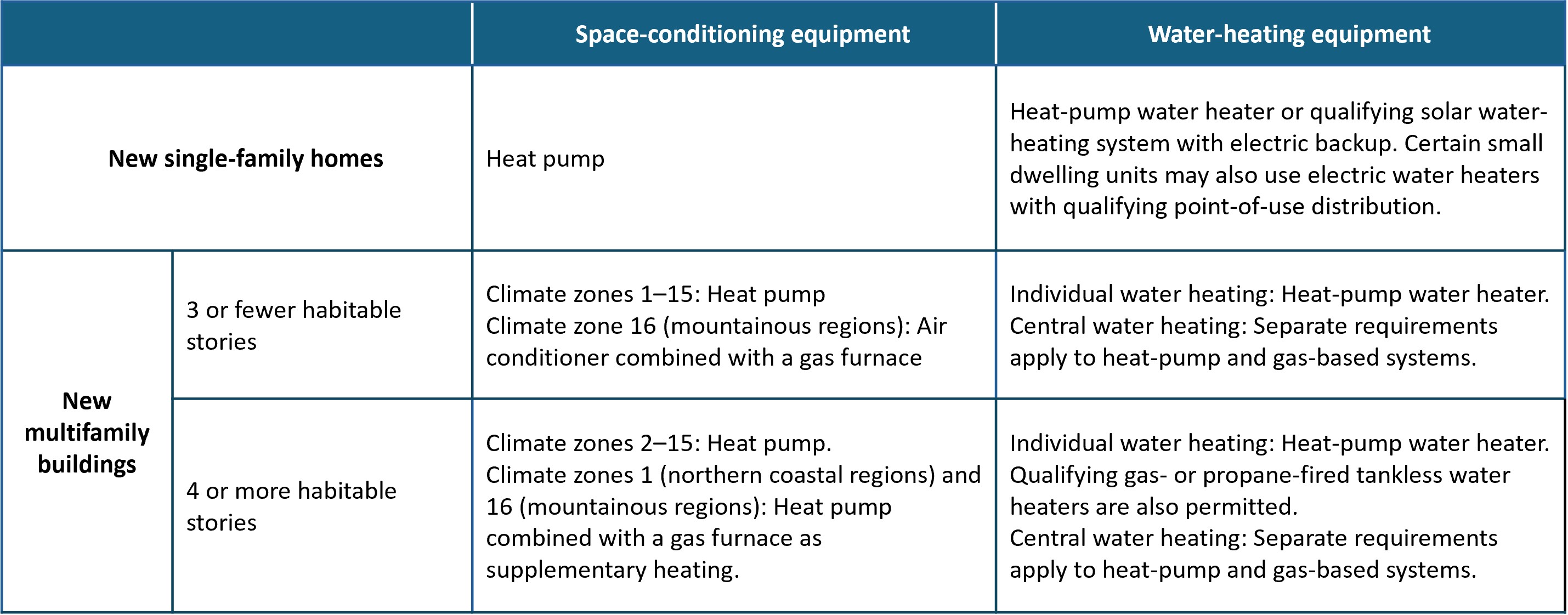
Importantly, California’s Energy Code does not directly ban gas heating. Instead, it strongly encourages the use of heat pumps. Builders may still install equipment that differs from the applicable prescriptive requirements, including a gas furnace in a new single-family home, by using the performance-compliance pathway and demonstrating that the proposed building meets the energy budget established by the code’s standard design. When gas or propane installations are used, builders must generally also prepare for future electric equipment (“electric-ready”). The detailed requirements are discussed in Section 4.
2.2 Existing buildings
New-construction requirements alone cannot drive the electrification of California’s existing building stock. The California Air Resources Board (CARB) estimates that the state adds about 112,000 new homes each year, compared with approximately 14 million existing homes. Policies must therefore also influence decisions made when heating and water-heating equipment in existing buildings reaches the replacement stage.9
CARB notes that installation needs vary by building and can include changes to equipment space, electrical panels, wiring or utility connections; heat pump water heaters can additionally require more space, drainage or airflow than existing combustion equipment. These are precisely the kinds of constraints that electric-ready requirements seek to avoid creating in new buildings.
To address equipment replacement across the wider building stock, CARB is developing statewide Clean Space and Water Heater Standards.10 The policy direction originates in California’s 2022 State Strategy for the State Implementation Plan11, which proposed a zero-emission standard for space and water heaters as part of the state’s air-quality strategy, and the 2022 Climate Change Scoping Plan12, which incorporated zero-emission heating into California’s pathway toward carbon neutrality. The regulation itself is still under development at the time of writing of this column. The current concept would limit the number of greenhouse-gas-emitting space and water heaters that manufacturers may sell in California, covering new equipment sold for both homes and businesses. Existing equipment could continue to be used and repaired; the rule would not require households to remove functioning heaters. However, over time, this would shift the replacement market toward zero-emission technologies. CARB is considering a zero-emission definition based on zero greenhouse-gas emissions during use, which could be met by technologies including heat pumps, electric-resistance heating and solar thermal systems.
At the regional level, primarily to reduce air pollution and protect public health, the Bay Area Air District adopted zero-nitrogen-oxide (NOx) requirements in March 2023 for covered furnaces and water heaters.13 The rules regulate covered equipment sales and installations, with applicability linked to equipment category and manufacture date. They do not require the removal of functioning heaters. Once the relevant compliance date is reached, covered appliances manufactured after that date must meet the zero-NOx standard. For small water heaters (typical residential water heaters), for example, the limit is 0 nanograms of NOx per joule of heat output, effectively requiring a non-combustion alternative such as a heat pump water heater. The adopted phase-in begins with small water heaters in 2027, followed by residential and commercial furnaces in 2029 and larger water heaters (commercial and multi-family) in 2031. However, in July 2026, the Air District proposed delaying the small-water-heater requirement to 2028 and adding exemptions addressing low income, electrical limitations, and space constraints.14 These changes have not yet been adopted, but they illustrate the practical challenges involved in converting existing buildings.
Both approaches seek to influence equipment choices at the point of replacement rather than require the immediate removal of existing appliances. Depending on how sales limits, phase-in schedules, and exemptions are designed, these regulations could gradually shift the replacement market away from fossil-fuel equipment and accelerate the electrification of existing buildings. Their implementation will therefore be important to watch.
3. Supporting measures that make electrification practical
The regulatory approaches discussed above are part of a broader policy framework in which targets, regulations, and supporting measures reinforce one another (Figure 1). Regulation can determine what equipment may be installed, but it does not remove the practical barriers to electrification. Households may face high upfront costs, additional building or electrical work, uncertainty about future energy bills, or difficulty finding qualified contractors. At the same time, utilities must decide whether continued investment in gas infrastructure remains economical as buildings electrify.
Figure 1: How targets, regulations, and supporting measures interact
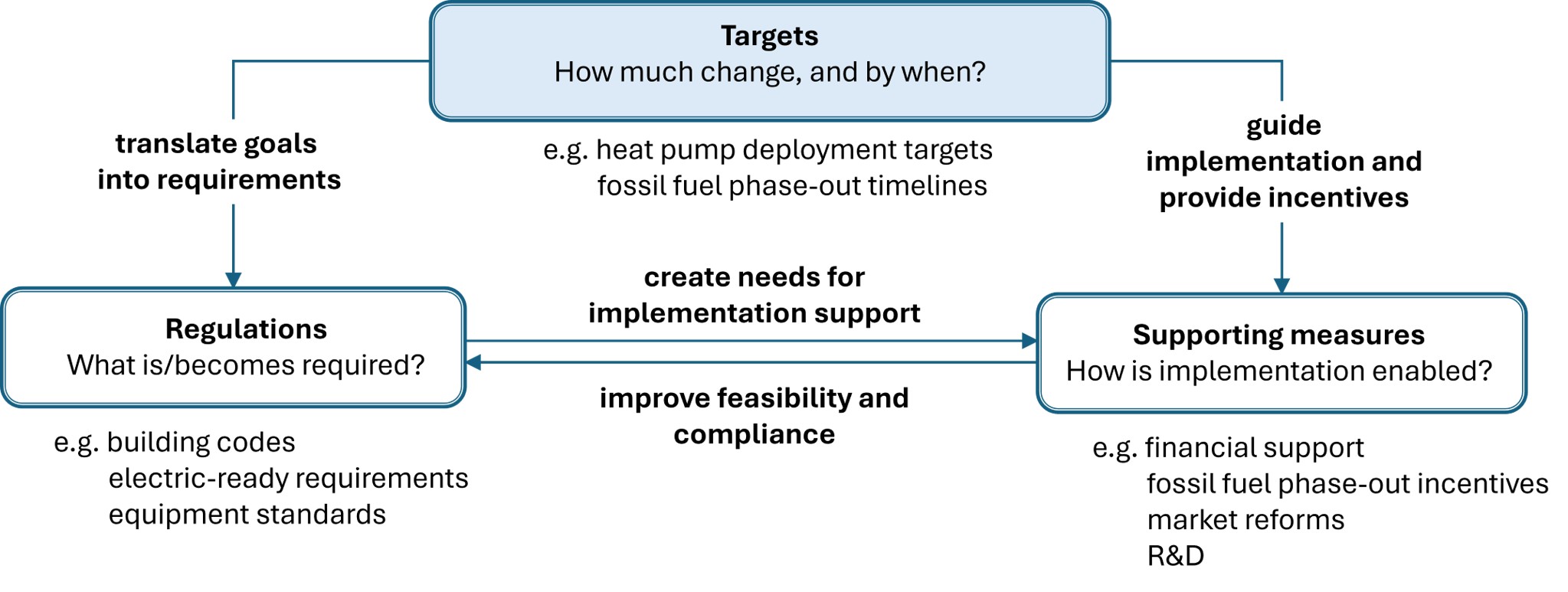
Below are some examples that illustrate how policy can address barriers ranging from the individual household to the wider energy network.
3.1 Reducing the cost of conversion (upfront costs)
In addition to the cost of the heat pump itself, the building work required for installation can make electrification unattractive or unaffordable. California uses several programs to address different parts of these upfront costs.
California’s Equitable Building Decarbonization Statewide Direct Install Program15 provides no-cost retrofits for eligible low-income households in selected communities. Every home served receives a heat pump for space heating and cooling, a heat-pump water heater, or both. Approved work may also include insulation, air sealing, electrical wiring, panel upgrades, and safety improvements. Regional administrators organize assessments and installations through participating contractors.
California also supports the construction of new all-electric homes. The California Electric Homes Program (CalEHP), launched in 2023, provides technical assistance and financial incentives to residential developers and builders constructing new market-rate homes with all-electric appliances and equipment.16
Other programs, such as TECH Clean California, have complemented this approach by supporting heat-pump deployment and market development, including incentives, technical assistance, pilot programs, and contractor training.17
3.2 Changing the incentives around gas and electricity connections
Another approach is to change the economics of new construction by withdrawing infrastructure subsidies from buildings that use fossil fuels.
California eliminated utility subsidies for infrastructure serving new buildings that use gas in two steps. Beginning July 1, 2023, the California Public Utilities Commission (CPUC) ended a system under which gas utilities used funds collected from customers through gas rates to subsidize part of the cost of extending gas distribution mains and installing service connections to new buildings, with limited exceptions.18 New buildings can still be connected to the gas network, but applicants, such as developers, generally have to pay the necessary infrastructure costs. From July 1, 2024, the CPUC also eliminated subsidies for extending electricity distribution lines and installing service connections to new mixed-fuel buildings (those using natural gas or propane in addition to electricity).19
This means that choosing a mixed-fuel building can affect not only the cost of the gas connection, but also the support available for the building’s electricity connection. New mixed-fuel buildings generally no longer qualify for the former applicable gas or electricity connection subsidies, while an all-electric building can still receive support for its electric connection.
Rather than subsidizing the expansion of gas service and then providing incentives to electrify buildings later, these measures change the economics of establishing new fossil-fuel infrastructure in the first place.
3.3 Addressing operating costs after installation
A household may be able to install a heat pump but still worry about its future electricity bill.
California addresses this barrier partly through electricity-rate design. Several large utilities offer time-of-use rate plans that can be particularly relevant to households using technologies such as heat pumps, electric vehicles, or batteries. These plans generally combine lower off-peak electricity prices with higher peak prices and a fixed charge, so whether a household saves depends on when and how much electricity it uses. In addition, California’s new residential billing structure shifts part of utility fixed costs from per-kWh charges to a monthly Base Services Charge, reducing volumetric electricity rates and thereby lowering the incremental cost of running electric equipment such as heat pumps. This measure is explicitly designed to support electrification of households. 20, 21,22, 23
Other states illustrate different approaches to the same operating-cost challenge. New York’s Energy Affordability Guarantee pilot provides bill assistance to qualifying low-income households that fully electrify their space and water heating, with the aim of keeping electricity expenditure at no more than 6% of annual household income.24 Massachusetts instead introduced seasonal heat-pump electricity rates: eligible customers of the state’s three major electric utilities receive lower delivery rates during the winter heating season, from November through April.25
3.4 Neighborhood electrification and gas infrastructure
Most electrification policies focus on individual buildings or appliances. But if enough customers leave the gas system while utilities continue maintaining the same pipelines for fewer remaining users, the transition also raises questions about the future of the gas network itself.
In 2024, California enacted Senate Bill (SB) 1221, establishing a framework for neighborhood-decarbonization pilot projects. Utilities can propose replacing the gas service in targeted areas with zero-emission alternatives, such as heat pumps, where doing so is more cost-effective than repairing, replacing, or continuing to operate the relevant gas infrastructure. The California Public Utilities Commission established the pilot proposal process in July 2026. Projects must demonstrate cost-effectiveness, reliable and affordable replacement energy service, community outreach and coordination, and consent from at least 67% of property owners in the project area. Up to 30 projects with this level of consent may be approved; projects obtaining 100% owner consent do not count toward that cap. The first utility applications are due April 1, 2027. Crucially, the framework does not itself provide a direct subsidy for the transition. Instead, it establishes a pathway for ending gas service at the neighborhood level. The 67% threshold concerns project approval: a project may be approved even if some property owners do not consent. After all affected customers have transitioned to suitable zero-emission alternatives, the CPUC may then relieve the gas utility of its obligation to serve the area. This establishes a regulatory pathway for retiring sections of the gas network that might otherwise need to be maintained for a declining number of customers.26 It remains to be seen whether the results of these pilot projects will lead to a broader regulatory framework for retiring gas infrastructure at the neighborhood level.
4. Electric-ready requirements: preparing for future electrification
Not every new building will be fully electrified from the outset. California's Energy Code therefore also addresses a longer-term concern: ensuring that buildings constructed with gas equipment today do not create unnecessary barriers to switching to electricity later.
What does “electric-ready” mean in practice?
Electric-ready design addresses the practical questions a future installer will face: Is an electrical connection available? Is there space for the equipment? Can condensate drain? Is there sufficient airflow? For residential buildings, California's electric-ready requirements cover space conditioning, water heating, cooking, and clothes drying, with additional provisions for shared multifamily systems. These requirements apply to newly constructed residential buildings when specified gas or propane equipment is installed.
Table 3: California’s electric-ready requirements for single-family homes and multifamily buildings
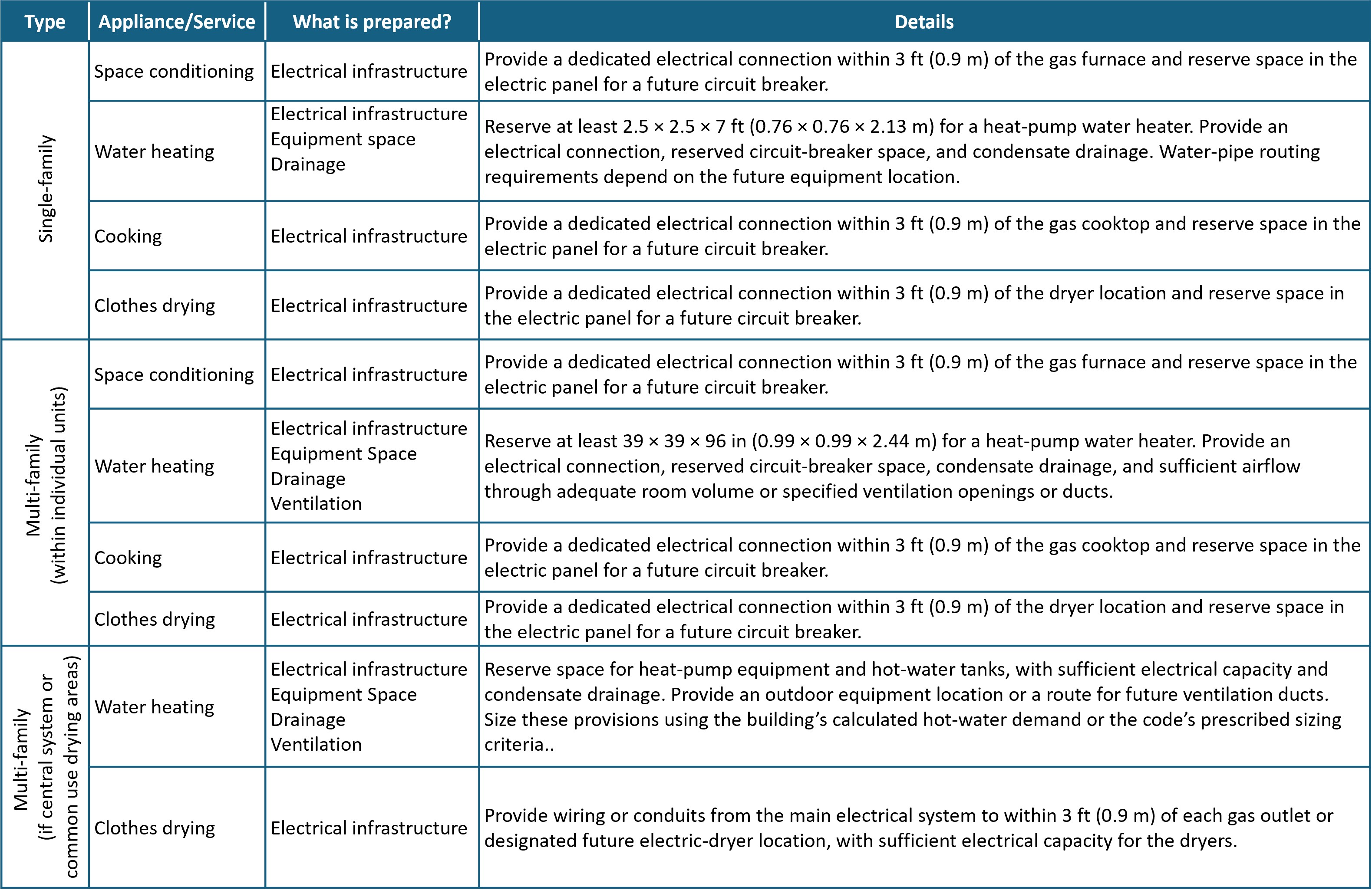
These requirements aim to make future heat-pump installations and the switch to efficient electric equipment easier and less costly.
Electric-ready requirements bring future electrification into the building-design process, rather than leaving the challenges entirely to future owners or occupants. They cannot remove every obstacle to retrofitting, nor do they substitute for policies that accelerate actual heat-pump deployment. Their value lies in preventing avoidable physical and financial barriers from becoming embedded in newly constructed buildings.
5. Conclusion
California's approach combines measures to accelerate electrification today with provisions to avoid creating new barriers to future electrification. For new buildings, California encourages all-electric construction while using electric-ready requirements to preserve future electrification options in buildings that are not fully electrified from the outset. For existing buildings, California’s policies seek to influence the equipment replacement market, encouraging a shift to electric heating and water-heating systems as existing equipment reaches the end of its useful life. California has also established a pilot framework to explore retiring gas infrastructure at the neighborhood level, addressing the challenge of maintaining gas networks as demand declines.
These approaches are complementary. While deployment targets, regulations, and financial incentives aim to increase electrification in practice, electric-ready requirements seek to prevent new carbon lock-in.
- IPCC, “IPCC Sixth Assessment Report”, accessed 2026/09/25
- California State, Governor Gavin Newsom webpage, “Governor Newsom Calls for Bold Actions to Move Faster Toward Climate Goals”, accessed 2026/09/25
- California Air Resources Board, “2022 Scoping Plan Documents”, accessed 2026/09/25
- New York State, Governor Kathy Hochul webpage, “Governor Hochul Announces Plan to Achieve 2 Million Climate-Friendly Homes by 2030”, accessed 2026/09/25
- California Energy Commission, “Top Global Building Appliance Manufacturers and Distributors Commit to Help California Achieve Six Million Heat Pump Goal”, accessed 2026/09/25
- California Heat Pump Partnership, “New public-private partnership forms to accelerate heat pump adoption in California”, accessed 2026/09/25
- California Energy Commission, “2025 Building Energy Efficiency Standards”, accessed 2026/09/25
- California Energy Commission, “2025 Building Energy Efficiency Standards for Residential and Nonresidential Buildings”, accessed 2026/09/25
- California Air Resources Board, “Clean Space and Water Heaters - FAQs”, accessed 2026/09/28
- California Air Resources Board, “Clean Space and Water Heater Standards”, accessed 2026/09/28
- California Air Resources Board, “2022 State Strategy for the State Implementation Plan”, accessed 2026/09/28
- California Air Resources Board, “2022 Scoping Plan Documents”, accessed 2026/09/28
- Bay Area Air District, “Building Appliances Rule Implementation”, accessed 2026/09/28
- Bay Area Air District, “Air District publishes draft changes to water heater rule that delay implementation and lower costs”, accessed 2026/09/30
- California Energy Commission, “EBD Statewide Direct Install Program”, accessed 2026/10/05
- California Energy Commission, “California Electric Homes Program (CalEHP)”, accessed 2026/10/08
- TECH Clean California, “TECH Clean California webpage”, accessed 2026/10/08
- California Public Utilities Commission, “CPUC Decision Makes California First State in Country to Eliminate natural Gas Subsidies”, accessed 2026/10/05
- California Public Utilities Commission, “CPUC Eliminates Last Remaining Utility Subsidies for New Construction of Buildings Using Natural Gas”, accessed 2026/10/05
- PG&E Utility, “Electric Home Rate Plan (E-ELEC)”, accessed 2026/10/05
- SDGE Utility, “Residential pricing plans”, accessed 2026/10/05
- Southern California Edison, “Time-of-use rate plans”, accessed 2026/10/05
- California Public Utilities Commission, “CPUC Approves A New Billing Structure That Will Cut Residential Electricity Prices and Accelerate Electrification”, accessed 2026/10/05
- New York State, Governor Kathy Hochul webpage, “Governor Hochul Announces Energy Affordability Guarantee Pilot Program for Low-Income Utility Customers”, accessed 2026/10/05
- Commonwealth of Massachusetts, “Residential electric seasonal heat pump rates”, accessed 2026/10/05
- California Public Utilities Commission, “Cost-Effective Neighborhood Decarbonization: SB 1221 Implementation”, accessed 2026/10/05
- California Energy Commission, “2025 Single-Family Electric Ready”, accessed 2026/09/28
- California Energy Commission, “2025 Multifamily Electric Ready”, accessed 2026/09/28
Series “The Overlooked Energy Transition: Electrification of the Heating Sector”
This column series aims to explore international trends in electrification policies, particularly those related to heat use, which are attracting growing attention from the perspectives of decarbonization and energy security. It also examines the challenges and potential of electrification in Japan, with the aim of developing policy recommendations.
No.1 From Energy Crisis to Electrification: Four Pillars of EU Policy (23 June 2026)
No.2 2026, A New Push for Electrification: The EU Electrification Action Plan and Lessons for Japan (26 August 2026)
No.3 California’s Approach to Building Electrification and Preventing Carbon Lock-In (10 November 2026)
<Related Links>
Special Contents Electrification and Decarbonization of Heat