
The full report is available in Japanese. An English summary is provided below.
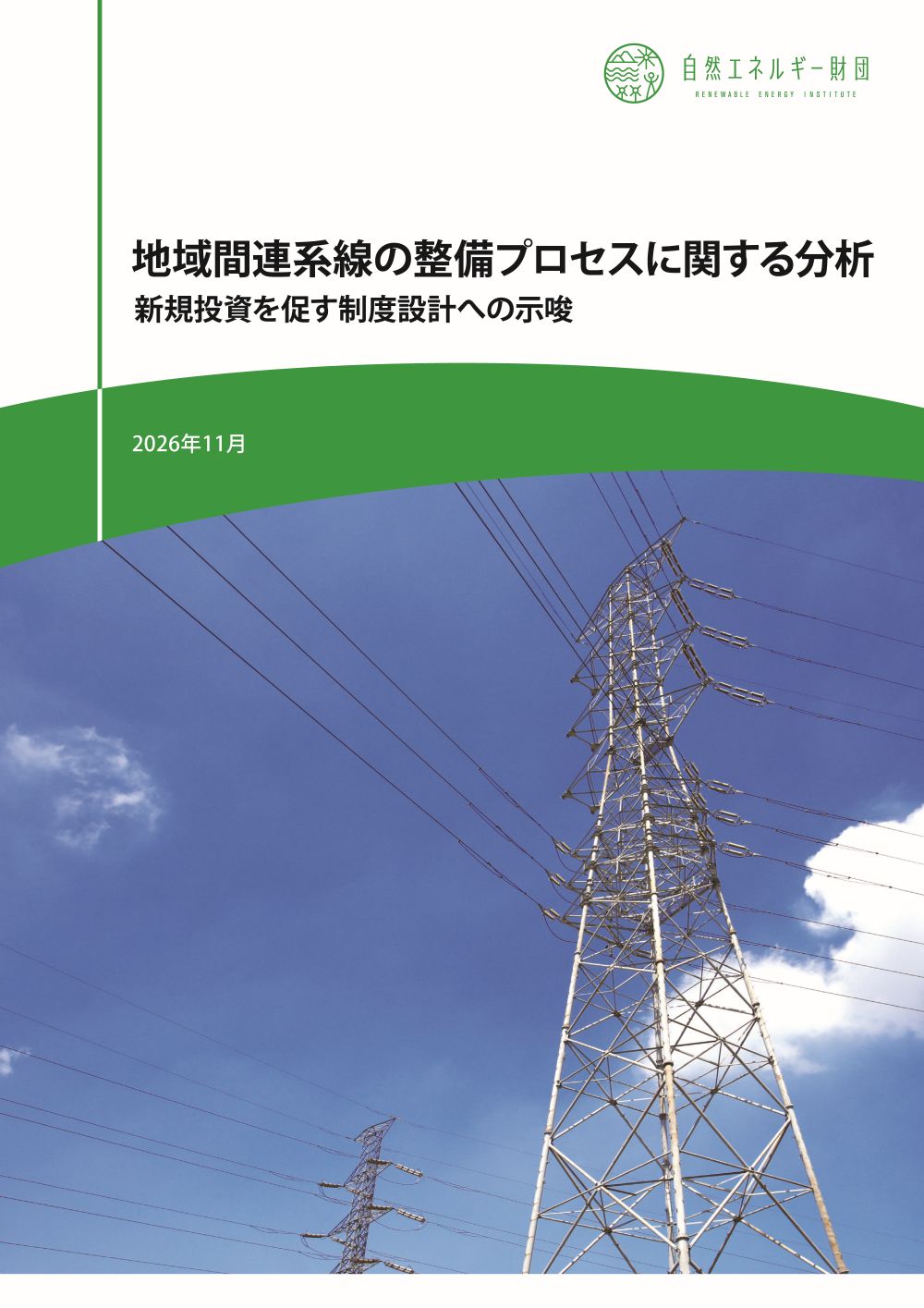

Renewable Energy Institute published a new report entitled “Analysis of the Development Process of Inter-regional Interconnectors: Implications for Institutional Design to Promote New Investment."
To achieve carbon neutrality in Japan, it is essential to develop inter-regional interconnectors that can transmit renewable power from regions with abundant renewable energy resources, such as Hokkaido, Tohoku, and Kyushu, to major power demand centers.
This report examines the history of inter-regional interconnector development in Japan and measures adopted overseas to promote transmission infrastructure development, and provides recommendations on institutional frameworks to accelerate future investment.
Regarding Japan, the report traces the evolution of inter-regional interconnector development, from efforts based on coordination among electric utilities under “the Central Electric Power Council” beginning in the 1950s, through the coordination mechanisms established by “the Electric Power System Council of Japan (ESCJ)”, to the Cross-regional Network Development Plans and the Master Plan for Cross-regional Network Development formulated by “the Organization for Cross-regional Coordination of Transmission Operators, Japan (OCCTO)”, since 2015.
Regarding measures to promote large-scale transmission investment overseas, the report reviews various support mechanisms, including revenue floor guarantees and measures to expedite investment cost recovery and regulatory approvals in the United Kingdom, the legal designation of strategically important transmission lines and public equity investment in transmission system operators in Germany, and subsidies and transmission capacity purchases in the United States. Based on these analyses, the report presents four recommendations:
- Recommendation 1: Update the Master Plan for Cross-regional Network Development to reflect changes in socioeconomic conditions.
- Recommendation 2: Strengthen the national government's leadership in developing interregional interconnectors.
- Recommendation 3: Showcase long-distance high-voltage direct current (HVDC) transmission and converter technologies, and establish a foundation for related industries.
- Recommendation 4: Establish programs to promote stakeholder understanding.
This analysis reaffirms that inter-regional interconnectors are essential social infrastructure supporting Japan's economy and the daily lives of people. Going forward, inter-regional interconnectors will also play a critical role as infrastructure supporting the achievement of carbon neutrality. For these reasons, it is necessary to accelerate their development through stronger public-sector involvement. We hope that this report will contribute to accelerating the development of interregional interconnectors in Japan.
<Related Links>
Symposium Building the Power Supply Infrastructure for GX: Meeting New Power Demand from DCs, Electrification, and Beyond with RE (28 October 2026)
Special Contents Electricity Grids