

On 28 February 2026, Israel and the United States launched coordinated attacks on Iran, almost exactly four years after Russia’s full-scale invasion of Ukraine on 24 February 2022. Both conflicts disrupted fossil-fuel supplies and sent shock waves through global energy markets. In the European Union (EU), however, the impact on electricity prices differed markedly. Day-ahead electricity prices skyrocketed in 2022 but remained comparatively low in 2026, with the rapid expansion of solar photovoltaic (PV) and battery storage playing a major role. By reducing reliance on expensive gas-fired generation, these technologies have also helped curb gas consumption and ease pressure on gas prices.
Day-Ahead Electricity Prices Are 61-76% Lower
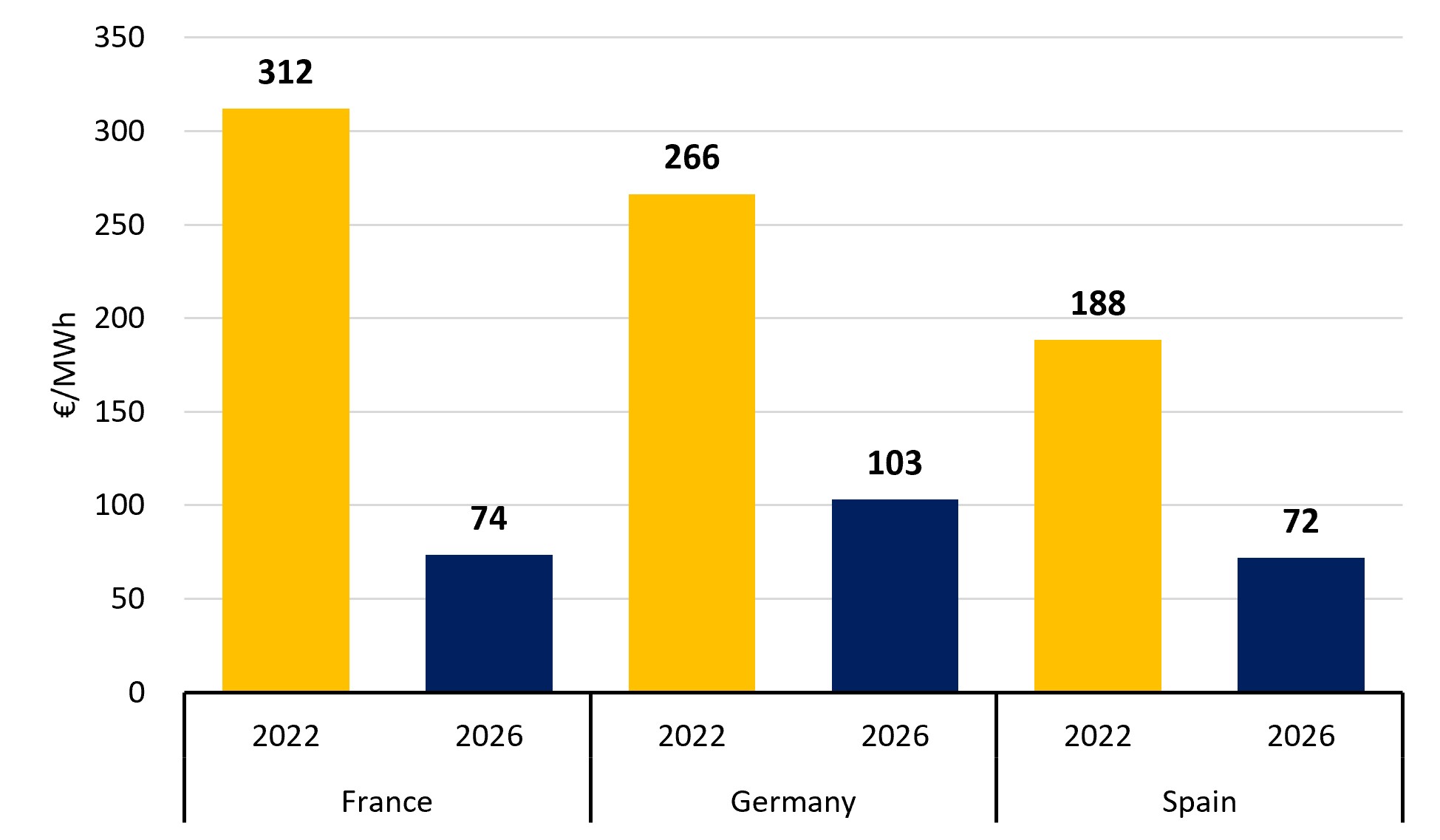
Across the EU’s three largest power systems—France, Germany, and Spain, which together account for nearly half of the bloc’s total electricity generation—day-ahead electricity prices from March to August 2026 were 61-76% lower than during the same six-month period in 2022 [Figure 1].
Figure 1: Day-Ahead Electricity Prices in Selected EU Countries, March-August 2022 and 2026
EU wholesale electricity markets operate according to the merit order principle. Under this system, power plants are dispatched in ascending order of marginal cost until supply meets demand, with the market price set by the marginal generator—the most expensive plant needed to meet demand. In the EU, marginal generators are typically fossil-fuel-fired plants, particularly coal- and gas-fired plants, reflecting their relatively high fuel and carbon costs.
A key reason for the decline in day-ahead electricity prices, therefore, is that the marginal generators setting prices in 2026 are considerably cheaper than those that set prices in 2022. As the following sections show, this shift has been driven largely by the rapid deployment of solar PV and battery capacity, which has reduced the need for more expensive fossil-fuel-fired generation.
Solar Generation Doubles as Fossil Generation Falls
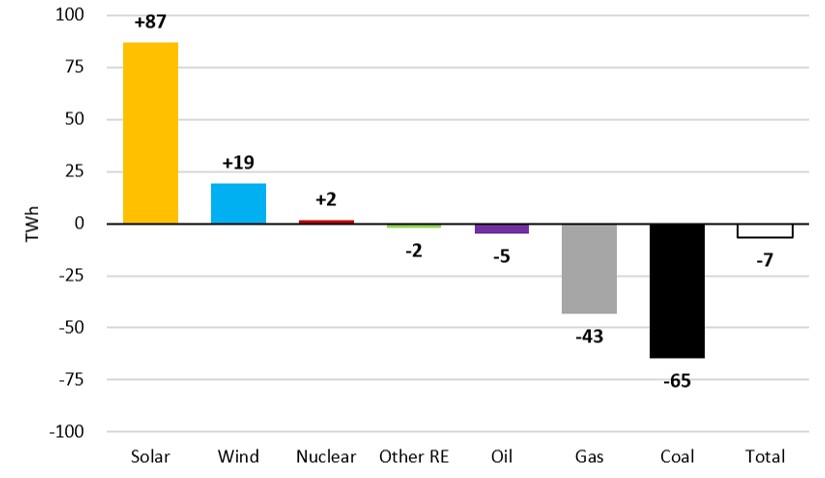
In the EU, electricity generation from solar—almost entirely solar PV—nearly doubled from March to June 2026 compared with the same four-month period in 2022 [Figure 2]. At the same time, coal- and gas-fired generation fell sharply, reflecting a broad shift toward generation with lower marginal costs.
Figure 2: Change in EU Electricity Generation by Technology, March-June 2022 and 2026
One visible consequence of growing solar generation is that negative prices have become a common feature of EU wholesale electricity markets.
Negative prices can occur when electricity supply from generators with very low marginal costs—notably solar and wind—exceeds demand, particularly when other generators are unable or find it uneconomic to reduce output. For example, paying to sell excess electricity can be less costly than shutting down and restarting generation.
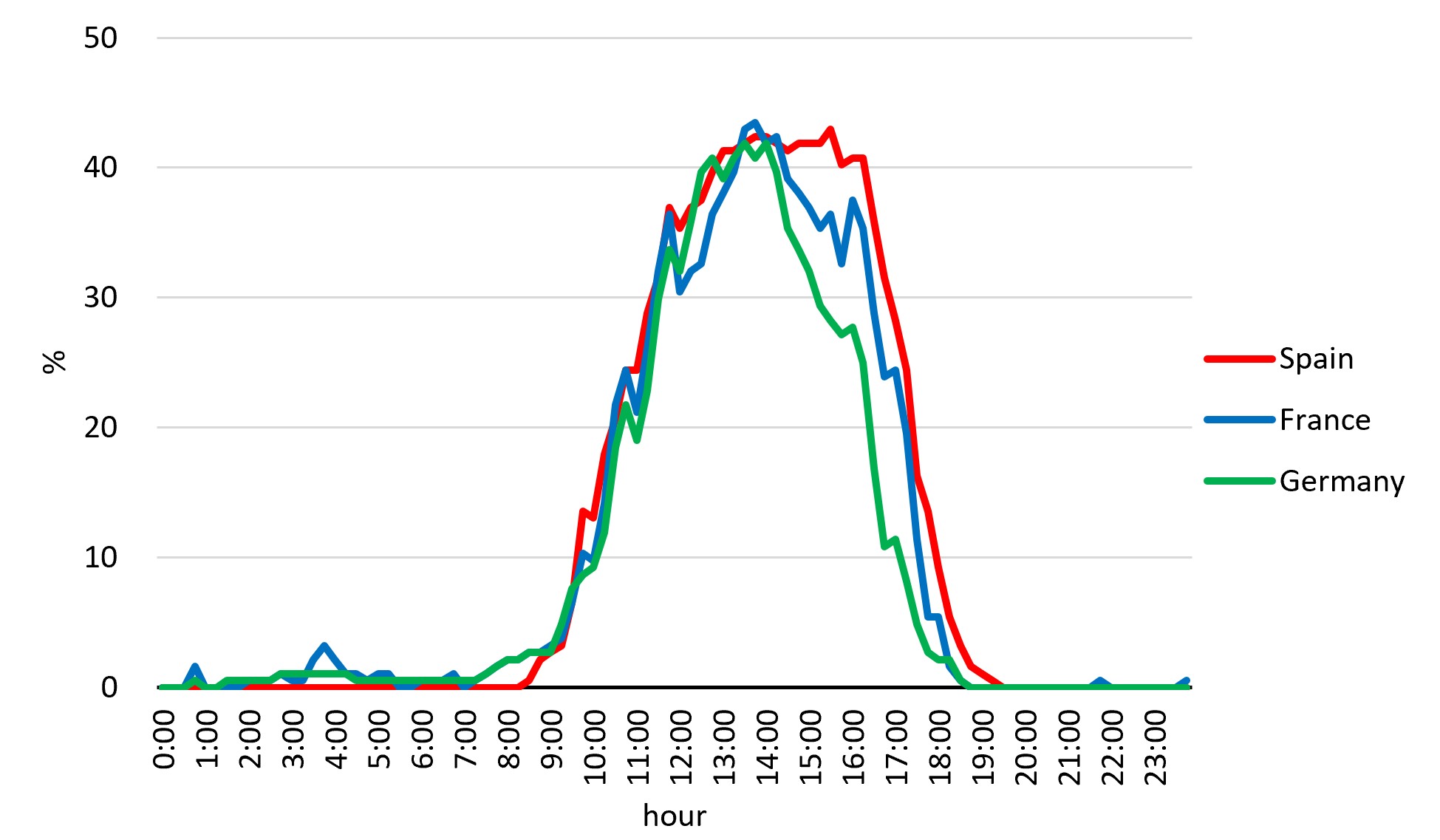
From March to August 2026, day-ahead electricity prices were negative 12% of the time in Spain, 11% in France, and 9% in Germany. By comparison, during the same six-month period in 2022, negative prices were rare, occurring only in Germany among the three countries.
These negative prices occurred mainly during daytime hours, when solar generation peaks [Figure 3].
Figure 3: Occurrence of Negative Electricity Prices by Time of Day in Selected EU Countries, March-August 2026
Negative prices create both challenges and opportunities, depending on the technology.
For nuclear reactors, which are generally less flexible than many other generation technologies, negative prices can result in financial losses. In France, however, the nuclear fleet is relatively flexible and can modulate its output in response to market prices. The transmission system operator Réseau de Transport d’Électricité (RTE) may nevertheless require some nuclear reactors to remain online during periods of low electricity prices to provide locally needed grid-support services, including voltage management. Électricité de France, the country’s sole nuclear plant operator, receives financial compensation under an agreement with RTE for maintaining this output. Such arrangements entail additional costs for the power system, highlighting the value of deploying alternative resources capable of providing these grid-support services, such as batteries.
Beyond providing grid-support services, batteries can also take advantage of low or negative wholesale electricity prices by charging when electricity is abundant and inexpensive. As solar generation expands and pushes down daytime electricity prices, these storage resources can absorb low-cost electricity and discharge it when prices are higher.
Rapid Battery Growth Reduces Reliance on Gas Peakers in the Evening
Across selected EU countries—Germany, Italy, France, Spain, Portugal, and Poland—cumulative battery capacity increased roughly sevenfold in power capacity (i.e., maximum instantaneous discharge capability) and eightfold in energy capacity (i.e., maximum amount of energy that can be stored) between the end of 2021 and the end of 2025 [Figure 4].
Figure 4: Cumulative Battery Storage Capacity in Selected EU Countries, 2021–2025
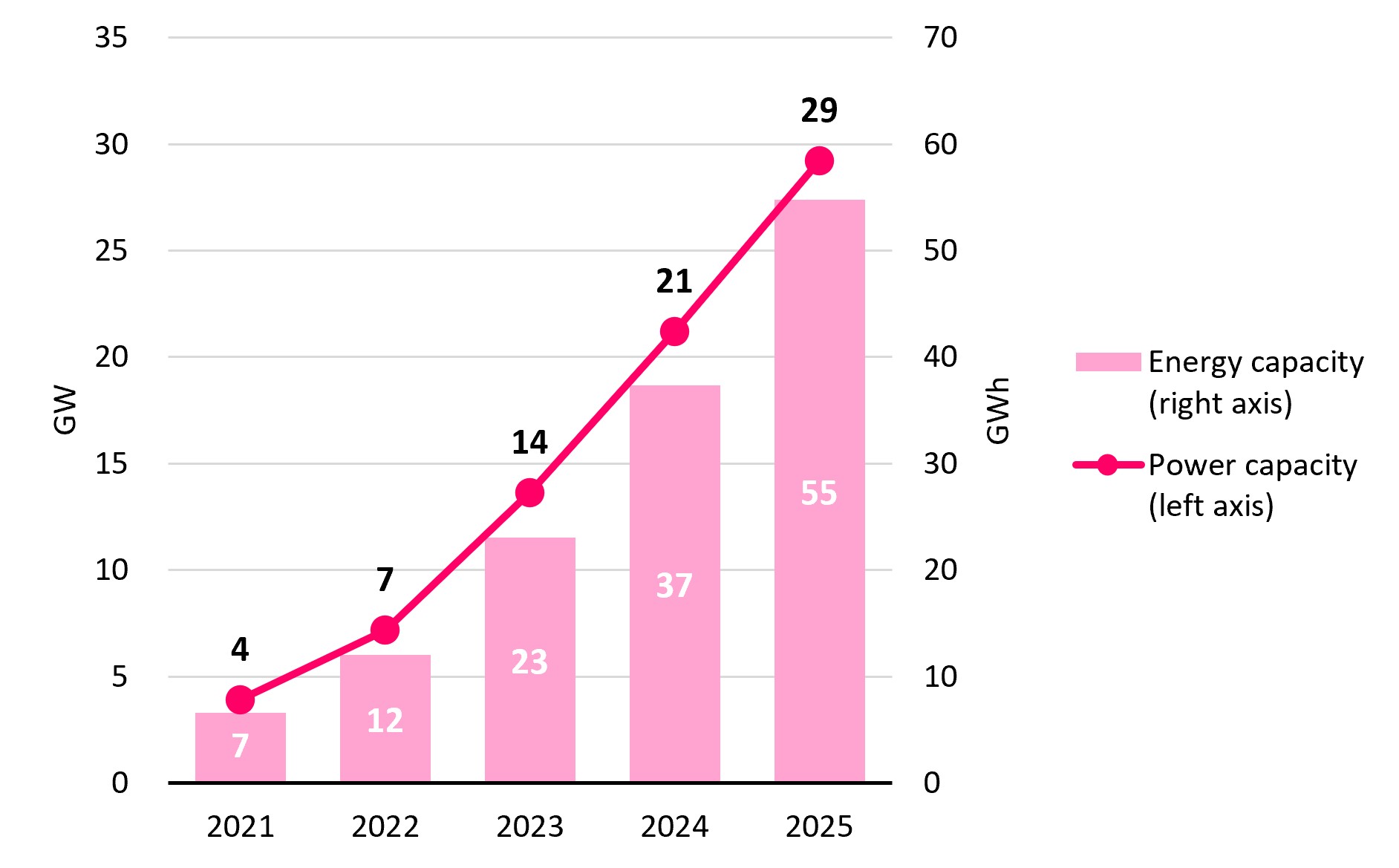
The faster growth in energy capacity than in power capacity also indicates a shift toward longer-duration batteries, particularly at the utility scale. While the duration of residential batteries remained slightly below two hours between 2021 and 2025 (1.8 hours in 2025), the duration of utility-scale batteries increased from 1.4 to 2.3 hours over the same period. This allows utility-scale batteries to store more abundant solar generation during daytime hours and shift it to periods of higher electricity demand and prices.
Thanks to falling technology and charging costs, batteries are increasingly able to compete with gas peakers in providing flexible power during evening hours, further reducing reliance on gas-fired generation.
Gas Generation Falls 27%, Driving Down Gas Consumption
The decline in gas-fired electricity generation has been an important factor behind lower EU natural gas consumption. From March to June 2026, gas-fired generation fell by 27% compared with the same four-month period in 2022. This decline was substantially larger than the 16% decrease in total gas consumption over the same period.1
Lower gas demand, in turn, helps reduce gas prices and the EU’s exposure to international gas-price shocks. From March to August 2026, benchmark European natural gas prices averaged $17/MMBtu.2 While still relatively high, this was 60% lower than the $43/MMBtu average recorded during the same six-month period in 2022.3
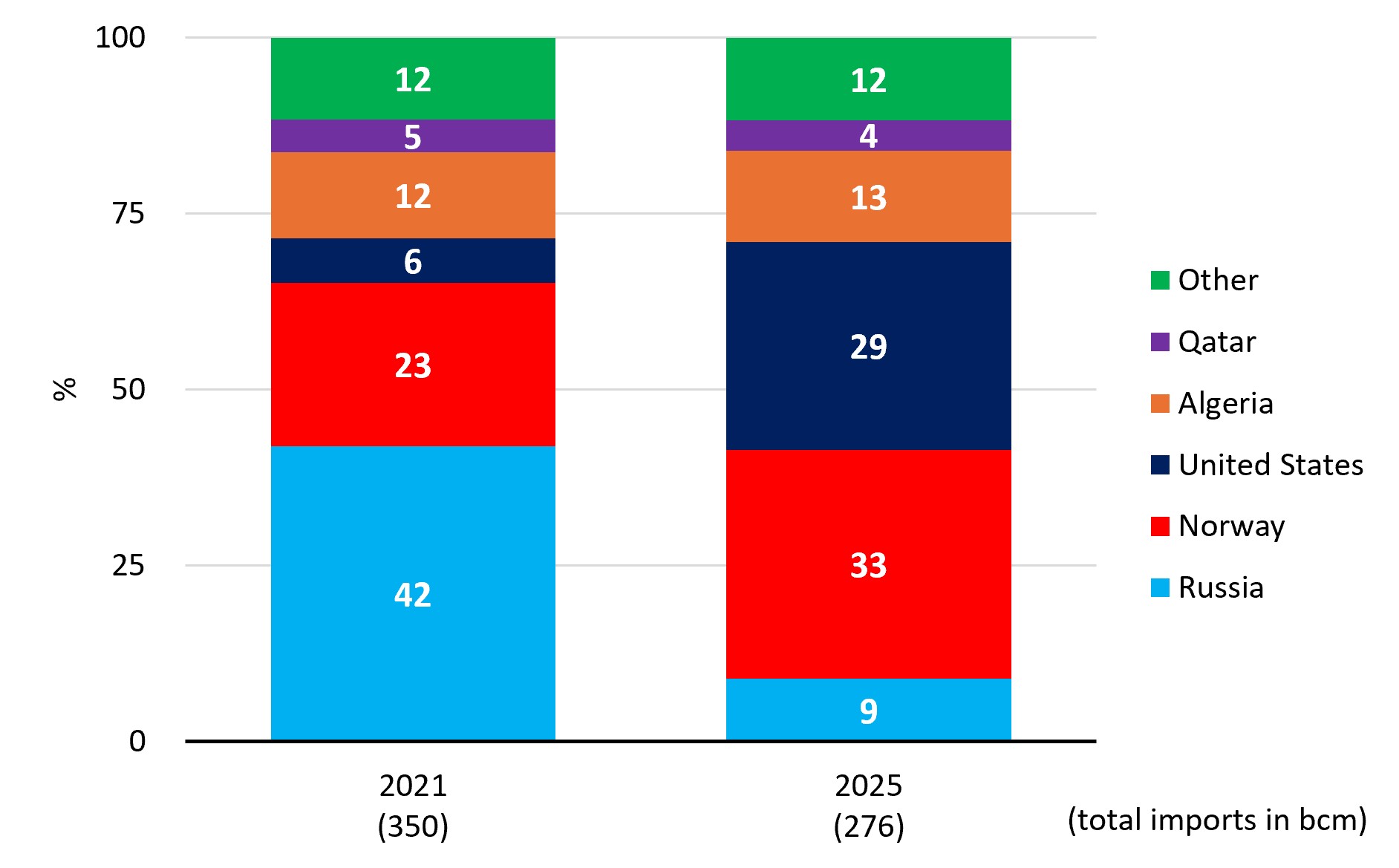
In parallel, gas-supply diversification has strengthened resilience on the supply side. The shift away from Russian pipeline gas toward American liquefied natural gas (LNG) and Norwegian gas, without a comparable increase in reliance on Middle Eastern LNG, has reduced the EU’s exposure to potential disruptions in the Strait of Hormuz—a risk long highlighted by energy experts [Figure 5].
Figure 5: EU Natural Gas Imports by Country of Origin, 2021 and 2025
Source: BP/Energy Institute, Statistical Review of World Energy 2022 (June 2022) and 2026 (June 2026).
The rapid expansion of solar PV and battery deployment has helped make EU countries less vulnerable to fossil-fuel price shocks. This has delivered important economic and energy-security gains, alongside environmental benefits. The lesson is particularly relevant for fossil-fuel-import-dependent Japan: accelerating the deployment of solar PV and batteries would reduce reliance on imported fuels and strengthen resilience to both geopolitical uncertainty and climate-related risks.
- Eurostat, Energy - Monthly Data (data downloaded 3 September 2026).
- World Bank Group, Commodity Markets: Monthly Prices (data downloaded 3 September 2026).
- Ibid.